
Australia at World Cup 2026: Socceroos in Group D
 Available in US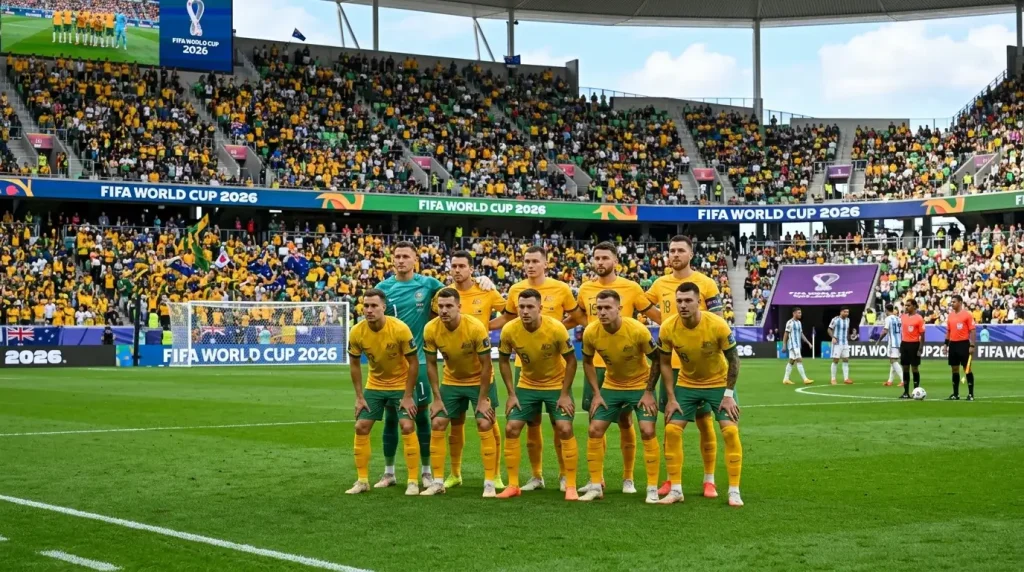
Table of Contents
The trans-Tasman rivalry intensifies when both nations reach football’s grandest stage simultaneously. Australia at World Cup 2026 means Kiwis will watch the Socceroos closely — some cheering for Oceania solidarity, others hoping our neighbours stumble spectacularly. I have covered this rivalry across multiple sports and understand the complicated emotions involved: we want the Socceroos to do well enough to prove Australasian football matters globally, but not so well that they lord it over us forever. Australia’s World Cup 2026 campaign in Group D presents genuine challenges that could deliver either outcome. For Kiwi punters, understanding the Socceroos matters both for trans-Tasman interest and because their results shape the tournament’s broader betting landscape.
Australia qualified for their sixth consecutive World Cup through Asia’s demanding pathway, demonstrating the consistency that separates them from most regional competitors. The Socceroos emerged from Qatar 2022 with enhanced reputation after their surprise knockout round appearance, and they carry genuine ambition into North America rather than simply participating to make up numbers. Group D pits them against hosts USA, South American quality in Paraguay, and European dark horses Türkiye — a draw that requires serious performances to survive.
Socceroos’ AFC Qualification
Asia’s qualification structure punishes complacency ruthlessly. Eighteen matches across four years, travel distances spanning thousands of kilometres, and opponents ranging from regional minnows to continental powers — the pathway to North America demanded stamina and professionalism from the Socceroos throughout. Australia finished the decisive third round in second place behind Japan, accumulating 21 points from 10 matches while scoring 22 goals and conceding 12. These numbers reflected solid rather than spectacular performances: good enough to qualify comfortably, insufficient to dominate.
Coach Graham Arnold stepped down following qualification, replaced by former Socceroos captain Tony Popovic. The transition period allowed Popovic to implement his tactical preferences across friendly matches and the Asian Cup, building familiarity before World Cup pressure arrives. Popovic brings a pragmatic approach that prioritises defensive solidity while leveraging Australian physicality in attacking situations. His teams press aggressively in certain moments while remaining disciplined positionally — a style that suits World Cup tournament football.
Key qualification victories came against Bahrain, China, and Oman, opponents Australia expected to beat but sometimes struggled against in previous cycles. The Socceroos’ improved clinical finishing compared to earlier qualifying campaigns suggested genuine progress under Arnold that Popovic inherited. Matches against Japan exposed Australian limitations against elite opposition — they lost both fixtures — but that disparity was expected rather than alarming.
The concerning pattern from qualification involved Australia’s away form against competitive opponents. They drew with Saudi Arabia and lost in Tokyo despite creating reasonable chances. World Cup matches are essentially neutral venues, but the psychological adjustment from playing hostile crowds could affect Socceroos unfamiliar with such environments. The USA fixture in Houston effectively represents a road game given American home support.
Key Players: Australia’s Squad
Australia lack the individual star power of major footballing nations but possess a cohesive unit where collective function exceeds individual parts. The Socceroos’ strength lies in organisation, work rate, and physical presence rather than technical brilliance — qualities that translate well to tournament football’s knockout intensity.
Jackson Irvine captains the side from central midfield, dictating tempo and providing leadership through communication and positioning. His experience in German and Scottish football prepared him for international competition’s demands, and he drives Australian pressing when the team commits to high-energy phases. Irvine’s physical frame makes him awkward to play against; he wins aerial duels and holds possession under pressure effectively.
Cameron Devlin operates as Irvine’s midfield partner, focusing on defensive coverage and recycling possession rather than creative contribution. The Hearts midfielder provides security that allows more adventurous teammates to express themselves without fearing counterattacks. His positioning intelligence compensates for limited pace, reading passing lanes before opponents can exploit them.
Adam Taggart leads the forward line following injuries that delayed his international prime. His finishing instincts and movement inside penalty areas create chances from crosses and through balls alike. Taggart’s World Cup 2022 absence through injury meant this tournament represents his first opportunity to demonstrate what he offers at football’s highest level. Backing him in scorer markets involves faith that his domestic form translates internationally.
Aziz Behich provides experience at left-back, having participated in multiple World Cups and Asian Cups. His understanding of tournament football’s rhythms helps younger teammates navigate pressure situations. Behich’s attacking contributions have diminished with age, but his defensive reliability and communication remain valuable.
Goalkeeper Mat Ryan brings Premier League experience to Australian goalkeeping. His shot-stopping ability has kept the Socceroos competitive in matches where they faced superior opposition, and his distribution initiates Australian attacks when possession builds from deep positions. Ryan’s leadership organises the defence and provides confidence throughout the squad.
Group D: USA, Paraguay, Türkiye
Australia landed in perhaps the most competitive group without an obvious favourite. USA enter as hosts with home advantage and a golden generation of talent. Paraguay bring South American pedigree and qualification experience. Türkiye possess European football’s organisation and individual quality. Any team could finish anywhere from first to fourth — genuine four-way competition rather than predetermined outcomes.
The USA fixture on June 12 in Houston opens Australia’s campaign against tournament hosts riding enormous expectation. American football has developed rapidly since 2022, with Christian Pulisic, Weston McKennie, and others now established at elite European clubs. The Socceroos face a hostile crowd and motivated opponents in their toughest group match. Surviving without defeat would represent significant achievement; winning would shock most observers.
Paraguay on June 18 in Dallas offers Australia their clearest path to three points. The South Americans qualified through CONMEBOL’s demanding competition but lack the individual quality of continental powers like Argentina or Brazil. Australia’s physical style matches Paraguay’s preferences, potentially producing an attritional battle decided by individual moments. This fixture likely determines Australian advancement hopes.
Türkiye on June 23 in Houston concludes Group D play with both teams potentially needing results. The Turkish qualified through UEFA as dark horses, combining experienced internationals with emerging talent from Istanbul’s big clubs. Matches between Australasia and Europe often produce tight affairs where tactical discipline matters more than technical superiority.
Realistic Australian ambitions target second place behind USA and advancement to knockout rounds. The expanded format that allows best third-place teams to progress provides additional hope — Australia potentially advance with four points if results elsewhere favour them. Bookmakers price Socceroos qualification around 2.25, reflecting genuine uncertainty about their prospects.
Australia World Cup 2026 Betting Odds
Australia’s outright odds approach 150.00 to win the World Cup — lottery ticket territory that reflects their ceiling as round of 16 exit candidates at best. Kiwi punters should ignore outright markets for the Socceroos entirely unless seeking pure entertainment value without realistic expectation of return.
Group D markets present more interesting opportunities. Australia to qualify at 2.25 implies roughly 44% probability, which feels slightly low given their squad quality relative to Paraguay and potential for USA upset. To win the group pays around 6.50 — achievable only if USA stumble and Australia find unexpected consistency across three matches.
Individual match betting offers the clearest value propositions. Australia versus Paraguay prices attractively for those backing the Socceroos to win their most winnable fixture. The USA match involves significant underdog odds for Australia; draw no bet protection offers middle ground between backing the Socceroos and accepting likely defeat.
Under/over markets suit Australian football’s profile. The Socceroos produce lower-scoring matches than their opponents typically manage, thanks to defensive organisation that limits high-quality chances. Under 2.5 goals in Australian fixtures should price consistently across their group matches, with the Türkiye encounter potentially producing especially cautious football.
Asian handicap betting reflects Australian status as slight underdogs in every group match. They concede starts against USA and Türkiye while sitting level against Paraguay. These spreads capture market assessment accurately — Australia are competitive but not favoured against any Group D opponent.
Trans-Tasman Rivalry: Both at the World Cup
New Zealand and Australia competing at the same World Cup generates unique Australasian interest that transcends typical sporting rivalries. The nations share cultural connections, competitive histories across multiple sports, and mutual desire to prove that football from this region matters globally. For Kiwi punters, the Socceroos represent both neighbours to support and rivals to outperform.
Australia exited OFC for AFC in 2006, leaving New Zealand as the region’s sole representative while the Socceroos accessed higher-quality competition. That decision accelerated Australian football development while complicating New Zealand’s path to World Cups. Twenty years later, both nations qualified for 2026 through different confederations — vindication for Australia’s move and validation for New Zealand’s perseverance.
The groups prevent direct trans-Tasman competition during the tournament, barring unexpected knockout round progression by both nations. However, Kiwi and Australian football communities will track each other’s results obsessively, comparing performances and debating whose campaign succeeded more convincingly. Bragging rights matter in neighbourly relationships, particularly when rugby historically dominates sporting comparisons.
For New Zealand supporters, Australian success would prove that Australasian football can compete internationally — beneficial for the entire region’s development. Simultaneously, Australian failure would provide satisfying schadenfreude for those who resented the AFC switch or enjoy any opportunity to celebrate over neighbours. The complicated emotions involved make trans-Tasman World Cup watching uniquely engaging.
Betting angles involving both nations include comparisons like “which team finishes higher in their group” or “which team advances further in the tournament.” These exotic markets appear occasionally at larger bookmakers, offering Kiwi punters opportunities to back their preferences while engaging with trans-Tasman rivalry productively.
Socceroos World Cup History
Australia at World Cup 2022 exceeded all expectations by reaching the knockout rounds for only the second time in their history. The Socceroos defeated Tunisia and drew with Denmark before losing to eventual champions Argentina in the round of 16. That tournament demonstrated Australian football had genuine quality rather than simply qualifying through Asia’s allocation — they competed rather than merely participated.
Germany 2006 remains Australia’s most celebrated World Cup campaign. They reached the knockout rounds by defeating Japan and drawing with Croatia, before a controversial defeat to Italy ended their run. That squad featured Tim Cahill, Mark Viduka, and Harry Kewell — genuine stars whose presence elevated Australian expectations permanently. The golden generation set standards that subsequent Socceroos have struggled to match.
World Cups between 2006 and 2022 produced three consecutive group stage exits. The Socceroos faced Brazil, Germany, and Spain across those tournaments — the draw was never kind — but also failed to defeat opponents they should have handled. Chile, Netherlands, and Peru all eliminated Australia from tournaments where advancement was theoretically possible with better results.
Australia’s overall World Cup record shows 6 wins, 4 draws, and 14 losses across six appearances. Their goal difference of minus 30 reflects the quality gap between Socceroos and elite opposition. These numbers provide context for realistic expectation management: Australia compete at World Cups without threatening to win them. Advancement beyond group stages represents success; anything further constitutes overachievement.
Can Australia Advance?
Australia should advance from Group D if they perform to level. That conditional statement captures the uncertainty surrounding Socceroos prospects — they possess sufficient quality for knockout rounds but could equally exit in the group stage without surprising anyone. The variance between outcomes reflects football’s inherent unpredictability rather than specific Australian deficiencies.
The USA fixture largely determines Australian fate. Avoiding defeat maintains realistic advancement hopes; losing creates immediate pressure that could compound across subsequent matches. Paraguay then becomes must-win, with Türkiye providing emergency backup if earlier results disappoint. This match sequencing means punters should evaluate Australia’s campaign through the USA result filter — everything flows from that opener.
For Kiwi observers, Australian success or failure provides context for New Zealand’s own World Cup experience. If the Socceroos advance while the All Whites struggle, questions about OFC versus AFC quality resurface. If both nations navigate group stages successfully, Australasian football celebrates together. If neither advances, the rivalry retreats to domestic competitions where both nations understand their level precisely. World Cup 2026 will clarify much about where trans-Tasman football stands globally.
