
World Cup 2026 Odds: Complete Betting Markets for NZ Punters
 Available in US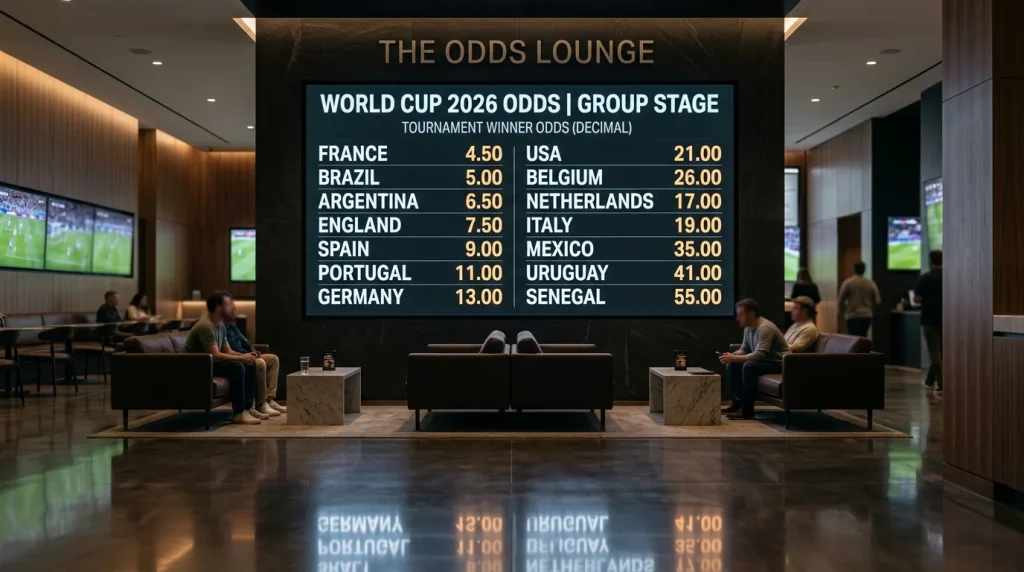
Table of Contents
I pulled up the odds board at 6am the morning after the World Cup draw was finalised, coffee in hand, fully expecting Argentina to sit at the top. They did — but what caught my attention was the gap. The defending champions priced at 5.50 while England languished at 8.00. That spread tells you everything about how the market views this tournament. Favourites are bunched tighter than I have seen in years, and that creates opportunities for anyone willing to dig deeper than the headline prices.
World Cup 2026 odds have settled into recognisable patterns now that we know the groups, but they remain fluid enough that sharp movements still occur weekly. For Kiwi punters accessing these markets through TAB NZ, understanding where prices sit today — and why they might shift tomorrow — separates informed betting from blind hope. This breakdown covers every major market from outright winner to top scorer, with particular attention to where New Zealand fits into the picture.
The expanded 48-team format has complicated traditional tournament betting in ways bookmakers are still adjusting to. More teams means more variance, more potential upsets, and more value hiding in plain sight for those who know where to look. Whether you are backing Argentina to defend their crown or hunting for that 34.00 dark horse, the numbers that follow will give you the foundation to make decisions with your eyes open.
Outright Winner Odds: Who’s the Favourite to Lift the Trophy?
A mate of mine backed Germany at 12.00 before the 2014 World Cup because he reckoned their midfield depth was being underrated. He collected handsomely when they lifted the trophy in Rio. That same logic applies now — the question is identifying which team’s price fails to reflect their actual chances. Let me walk you through the market leaders and where I see the genuine value sitting.
Argentina currently heads most outright markets at around 5.50, reflecting their status as defending champions and the lingering Messi factor. Whether Lionel Messi actually plays remains uncertain, but the market has priced in the possibility. Their 2022 triumph and subsequent Copa America success have cemented them as the team to beat, though that price is tight enough that I struggle to see value there. You are essentially betting at odds that suggest an 18% implied probability — reasonable for a team that has demonstrated tournament-winning pedigree, but not exactly generous.
France sits second in most books at approximately 6.00, and this price genuinely puzzles me. They reached the 2022 final, possess perhaps the deepest squad in world football with Mbappé leading the line, and have the kind of tournament experience that money cannot buy. The 2018 champions have a legitimate argument for being underpriced at current levels. Their spine of Maignan, Tchouaméni, and Mbappé gives them solutions against any opponent, and Didier Deschamps knows how to navigate knockout football better than almost any manager alive.
England hover around 8.00, and the market clearly views their recent final losses as evidence of a psychological ceiling rather than proximity to success. I see it differently. A team that reaches major tournament finals with the regularity England has demonstrated is not cursed — they are knocking on the door. The squad features world-class players across every position, and the Premier League’s intensity means these players are battle-hardened against top opposition week in, week out. At 8.00, England represent one of the better value propositions among the favourites.
Brazil commands prices around 7.00 despite their quarterfinal exit in 2022, reflecting the market’s respect for their talent pool and their historical tournament pedigree. The Seleção have won five World Cups, more than any other nation, and their current generation features genuine stars in Vinícius Jr, Rodrygo, and the emerging Endrick. However, I would want to see evidence that their defensive issues have been resolved before backing them at these prices. Talent alone does not win tournaments — organisation does.
Spain represent fascinating value at approximately 9.00 following their Euro 2024 triumph. That victory showcased a young, hungry squad with Lamine Yamal and Nico Williams providing genuine X-factor on the flanks. The Spanish federation has rebuilt intelligently after their tiki-taka decline, and this team plays with an intensity and directness that differs markedly from their possession-dominant predecessors. At 9.00, they offer genuine each-way appeal for punters who believe European Championship form translates to World Cup success.
Germany sit around 10.00 as hosts across three venues, though the tournament’s true home is the United States. This price might tempt some based on their 2014 triumph and historical tournament nous, but I see too many squad questions to back them confidently. The regeneration that served them well under Nagelsmann in qualifying needs to prove itself against elite opposition in knockout football. Germany rarely disappoint at home, but this is not quite a home World Cup in the traditional sense.
Portugal, Netherlands, and Belgium all hover between 12.00 and 17.00, representing the next tier of contenders. Belgium’s golden generation has one last shot with De Bruyne, Lukaku, and Courtois all likely in their final World Cup — Group G opponents that Kiwi punters will watch closely. Portugal’s Cristiano Ronaldo situation mirrors Argentina’s Messi question, though his involvement seems more certain. The Netherlands bring Virgil van Dijk’s defensive organisation but lack the cutting edge that defined their historical greats.
Dark Horses: Value Picks Beyond the Big Names
Every World Cup produces a story nobody predicted. South Korea reaching the semifinals in 2002. Croatia making the final in 2018. Morocco’s fairytale run to the last four in 2022. The expanded format makes these stories more likely, not less, because the round of 32 adds an extra knockout round where upsets can compound. Finding value in this bracket requires accepting that traditional powerhouses can stumble.
Croatia at 26.00 stands out immediately. This nation of four million people reached the final in 2018 and finished third in 2022 — consecutive deep runs that suggest their success was not fluky. Luka Modrić may finally be slowing, but the conveyor belt of Croatian midfield talent continues with Kovačić and Brozović providing elite-level control. Their Group L draw against England, Ghana, and Slovakia presents a clear path to the knockout rounds, and once there, Croatia’s tournament pedigree takes over. At 26.00, I consider them mispriced by at least 30%.
Denmark occupy an interesting space around 34.00. Their Euro 2020 run to the semifinals came with the emotional weight of Christian Eriksen’s cardiac arrest, and that group has matured into a cohesive unit under Kasper Hjulmand. The Danes defend brilliantly as a collective, and against the more open play typical of World Cup football, that defensive structure can frustrate higher-ranked opponents. Group K features Colombia, Senegal, and Panama — challenging but winnable with three points from each match achievable.
Senegal at 67.00 deserve consideration given their 2022 round of 16 appearance and the quality of Sadio Mané and Ismaïla Sarr. African teams have historically struggled to convert group stage success into deep knockout runs, but the expanded format gives them more room to settle. Their price reflects historical bias more than current reality, and at 67.00, even a quarterfinal appearance returns substantial value.
Japan represent the AFC’s best chance at a deep run, priced around 51.00. Their victories over Germany and Spain in 2022 demonstrated that quality exists within their squad, and the core of that team remains intact. Japanese football has produced a generation of players competing in Europe’s top leagues, from Mitoma at Brighton to Doan at Freiburg. Their tactical discipline and fitness levels mean they can compete with anyone over 90 minutes. Group F against Netherlands, Tunisia, and Sweden presents opportunities.
Morocco’s 2022 semifinal run reset expectations for African teams, and they currently sit around 34.00 despite losing several key players. This price assumes their tournament nous carries forward to a largely new group — a bet I am less confident in. Achraf Hakimi remains elite at right-back, but the centre-back partnership that frustrated Belgium, Spain, and Portugal has aged. Morocco warrant monitoring rather than immediate backing.
USA as co-hosts at 28.00 present a fascinating proposition. Home advantage at a World Cup historically provides a significant boost, and the American soccer infrastructure has genuinely improved since their 2014 round of 16 exit. Christian Pulisic leads a squad with genuine European quality throughout, and their Group D draw alongside Paraguay, Australia, and Türkiye should see them progress comfortably. Whether they can handle the pressure of knockout football on home soil remains the question — at 28.00, the market clearly has doubts.
Group Winner Odds: All 12 Groups at a Glance
The night the draw was made, I mapped out every group winner market and noticed something peculiar — the favourite in Group G was priced tighter than several supposedly stronger groups. Belgium at 1.57 to win a group containing Egypt, Iran, and New Zealand seemed too short. That observation applies across multiple groups where the market has perhaps overreacted to perceived quality gaps.
Group A features Mexico as clear favourites at 1.75, opening the tournament against South Africa at Estadio Azteca. The host nation advantage combined with passionate home support makes them difficult to oppose, though South Korea at 3.50 provides interesting each-way value given their knockout tournament pedigree.
Group B presents Canada’s moment in the spotlight as co-hosts, priced around 2.50 with Switzerland at 2.20 the marginal favourite. This group looks genuinely open, with Qatar and Bosnia and Herzegovina both capable of causing problems. The Swiss price represents fair value given their consistent performances at recent tournaments.
Group C pits Brazil against Morocco in what could have been a quarterfinal pairing. Brazil at 1.40 seem underpriced given Morocco’s 2022 semifinal run, and I would want better odds before backing the Seleção to top this group. Scotland and Haiti complete the quartet, with the Scots potentially benefiting if Brazil and Morocco take points off each other.
Group D centres on the United States at 1.60, facing Australia, Paraguay, and Türkiye. This represents our trans-Tasman neighbours’ best World Cup chance in years, and the Socceroos at 5.50 to win the group offers genuine value if the USA stumble against either South American or European opposition. Türkiye at 4.50 warrant consideration as well given their Euro 2024 quarterfinal appearance.
Group E sees Germany head a tricky collection including Côte d’Ivoire, Ecuador, and Curaçao. The Germans at 1.45 have too much quality for this group, but their prices do not leave room for value. Ecuador at 6.00 outperformed expectations in 2022 and could push for second place.
Group F matches Netherlands against Japan in the tie everyone circled. Netherlands at 1.70 should progress, but Japan at 3.20 represent genuine value given their recent World Cup performances. Tunisia and Sweden complete the group with each capable of causing upset results.
Group G — our group — features Belgium at 1.57, Egypt at 3.50, Iran at 7.00, and New Zealand at 13.00. I will address our chances in detail shortly, but Belgium’s price to top the group assumes no defensive regression from an aging squad. Egypt with Mo Salah provide legitimate competition for top spot.
Group H contains Spain at 1.50 alongside Uruguay, Saudi Arabia, and Cape Verde. Spain should cruise through as favourites, with Uruguay at 2.80 offering value as second-favourites despite their aging core. Saudi Arabia’s shock victory over Argentina in 2022 proves they can produce magical moments.
Group I pairs France with Senegal in another match worthy of later rounds. France at 1.35 are too short, with their price leaving no room for Senegalese resistance. Norway at 8.50 and Iraq at 26.00 complete the group with limited prospects of progression.
Group J features defending champions Argentina at 1.30, a price that essentially treats their group stage as a formality. Algeria at 6.00, Austria at 8.00, and DR Congo at 15.00 round out the quartet. Algeria’s North African support and Riyad Mahrez’s quality make them the best each-way option if Argentina rotate heavily.
Group K puts Colombia at 1.90 against Senegal at 2.80, Denmark at 3.50, and Panama at 10.00. This open group could see any of the top three progress, making group winner betting particularly attractive for value seekers willing to oppose Colombia.
Group L matches England at 1.55 with Croatia at 3.50, Ghana at 7.00, and Slovakia at 9.00. The Three Lions should progress comfortably, but Croatia’s price to win the group offers genuine value given their tournament history. England’s habit of qualifying cautiously rather than emphatically could see Croatia pinch top spot.
All Whites Odds: New Zealand’s Chances in Group G
The odds board shows New Zealand at 1001.00 to win the World Cup. I laughed when I first saw it — not because it is unrealistic, but because someone somewhere will put a fiver on it anyway. Our chances of lifting the trophy are essentially zero, but that does not mean there is no value in the All Whites’ tournament betting markets. The real opportunities lie elsewhere.
To exit at the group stage, New Zealand are priced at 1.57, implying roughly 64% probability. This seems about right given the quality gap between us and Belgium, though I would argue the market slightly underrates our chances of causing an upset. For context, the All Whites remained unbeaten at the 2010 World Cup with three draws — including against defending champions Italy. We know how to frustrate superior opposition.
To advance from Group G, we are priced around 2.38, suggesting approximately 42% implied probability. This represents the most interesting market for Kiwi punters who believe in the team. The expanded format means eight third-placed teams qualify for the round of 32, fundamentally changing the mathematics of group stage survival. We need not beat Belgium or Egypt to progress — we need to accumulate enough points to rank among the best third-placed finishers across all twelve groups.
Our match-by-match odds tell the story clearly. Against Iran in our opener at SoFi Stadium, New Zealand are priced around 4.50 to win, with the draw at 3.40 and Iran at 1.95. That opening match is crucial — Iran finished above England in 2022 group betting despite losing all three matches, but their tournament experience gives them a slight edge over us in market perception. I see this as a genuine 50-50 match that bookmakers have tilted toward the more familiar opponent.
Against Egypt in Vancouver, the All Whites face similar odds with Egypt around 1.70 favourites, the draw at 3.60, and New Zealand at 5.00. Mo Salah’s presence skews this market significantly — without him, these prices would look very different. The Vancouver match offers potential value if Salah carries any injury concerns into the tournament.
Against Belgium in our final group match, we are priced around 10.00 to win with Belgium at 1.35 and the draw at 5.50. These prices assume Belgium play their strongest XI, which may not occur if they have already secured progression. The draw represents interesting value at 5.50 if Belgium are already through and rotating their squad.
Chris Wood to score anytime against any opponent ranges from 2.80 to 4.50 depending on the match. Our talisman carries our biggest individual market, and his Premier League form with Nottingham Forest demonstrates he can finish against quality opposition. Wood at 2.80 against Iran represents my best individual bet from New Zealand’s group stage campaign.
To win Group G, New Zealand are priced at 26.00. This is a lottery ticket pure and simple — you are betting on Belgium collapsing, Egypt underperforming, and our lads playing the tournament of their lives. At 26.00, a small stake cannot hurt for sentimental value, but this is not a serious betting proposition. Our realistic ceiling is scraping through as third place, and that is what I am targeting.
Golden Boot Odds: Who’ll Be the Tournament’s Top Scorer?
Harry Kane has finished as leading scorer in World Cup years before without winning the Golden Boot outright — a reminder that this market involves as much luck as it does quality. The 2022 winner was Kylian Mbappé with eight goals, benefiting from France’s run to the final and his ability to take penalties. Finding the 2026 Golden Boot winner requires identifying a combination of individual quality, team progression, and set-piece responsibility.
Mbappé heads the market at approximately 8.00, and despite my general scepticism about favourites, this price has merit. France should progress deep into the tournament, Mbappé takes penalties, and his pace creates chances even against the most organised defences. The main concern is whether Mbappé’s knee injury history catches up with him during a gruelling 48-team tournament that stretches over 39 days.
Kane sits around 10.00, and England’s expected progression through Group L into the knockout rounds gives him ample opportunity. Kane’s conversion rate at international level remains elite, and England’s attacking system funnels chances through him regularly. The uncertainty around England’s ability to win knockout matches introduces risk, but Kane should accumulate goals even if England exit in the quarterfinals.
Vinícius Jr at 12.00 represents Brazil’s main attacking threat, though his tendency to drift wide reduces his goal-scoring opportunities compared to a pure striker. His price reflects name recognition as much as realistic Golden Boot chances. Similarly, Erling Haaland at 11.00 for Norway assumes his nation progresses deep enough for him to accumulate goals — Group I with France makes that unlikely.
Romelu Lukaku at 14.00 for Belgium presents interesting value given Group G’s perceived weakness. If Belgium cruise through with Lukaku starting every match, he could enter the knockout rounds with four or five goals already. Belgium’s attacking system channels through Lukaku more consistently than most nations use their central striker, giving him a statistical edge in shot volume.
The each-way market is where I see genuine value. Rasmus Højlund at 26.00 for Denmark offers each-way appeal if Denmark’s group stage goes smoothly. Darwin Núñez at 20.00 for Uruguay provides similar value given their likely path through Group H. Both are clinical finishers who can accumulate goals in bunches when opportunities arise.
Chris Wood at 201.00 for New Zealand falls into the extreme long-shot category. Winning the Golden Boot requires approximately 6-8 goals based on historical data, which would mean Wood scoring in every match New Zealand plays — unlikely given we are expected to exit in the group stage. However, for a nominal stake, there is something appealing about a Kiwi leading the tournament in goals, however improbable.
Special Markets: Young Player, Best Goalkeeper, and More
Tournament specials have proliferated in recent years as bookmakers seek new angles on major events. These markets often contain more value than outright winner odds because they attract less sharp money. Understanding which special markets offer genuine betting opportunities requires knowing how the awards are typically decided and which players are positioned to benefit.
The Best Young Player award at World Cups typically goes to a player who makes a significant tournament impact rather than simply accumulating statistics. Previous winners include Mbappé in 2018 and Enzo Fernández in 2022 — players whose teams progressed deep while they personally contributed decisive moments. The market currently favours Lamine Yamal at 4.00 for Spain, Jude Bellingham at 5.50 for England, and Florian Wirtz at 8.00 for Germany.
Yamal’s price reflects his exceptional Euro 2024 performances and Spain’s likelihood of deep progression. At 17 years old during the group stage, he qualifies easily for the award and has already demonstrated big-game temperament. The risk is whether Spain’s attacking wealth limits his individual impact — Nico Williams, Pedri, and others all demand the ball. At 4.00, Yamal’s price is fair but not generous.
Bellingham at 5.50 offers better value despite his higher profile. England’s attacking system revolves around his forward runs from midfield, and any deep England run would involve Bellingham prominently. His age qualifies him for the award, and his capacity to score decisive goals matches the profile of previous winners. If England reach the semifinals, Bellingham likely wins this market.
The Golden Glove for best goalkeeper traditionally goes to a keeper whose team progresses furthest while keeping clean sheets. Ederson at 8.00 for Brazil, Courtois at 9.00 for Belgium, and Pickford at 11.00 for England lead the market. I favour Pickford at his price given England’s defensive organisation and likelihood of keeping opponents at arm’s length rather than engaging in open matches.
Most assists represents another market where the connection to team progression matters heavily. Kevin De Bruyne at 6.00 for Belgium and Mbappé at 8.00 for France lead this market, with playmakers from expected semifinalists dominating. De Bruyne’s price assumes Belgium’s progression through a relatively weak Group G translates to knockout success — a bet I am less confident in given their defensive concerns.
Team-specific markets offer interesting angles as well. Highest-scoring group at 5.00 for Group C featuring Brazil and Morocco attracts attention, while most red cards at 4.50 for Group D with its historically feisty encounters between South American and European nations presents a different kind of proposition. These niche markets reward specific knowledge about team tendencies and playing styles.

How World Cup Odds Change: Injuries, Form, and Market Moves
Three weeks before the 2022 World Cup, France lost Paul Pogba and N’Golo Kanté to injury. Their outright odds drifted from 6.00 to 8.00 almost overnight. Pogba and Kanté ended up not being missed as France reached the final anyway — a lesson in how market movements often overreact to news before correcting themselves. Understanding these dynamics helps you find value others miss.
Injury news creates the most dramatic market movements during the buildup to major tournaments. Key player injuries typically shift outright odds by 15-25% depending on the player’s importance. When Vinícius Jr suffered a muscle problem in March 2026, Brazil’s odds drifted from 6.50 to 7.50 before returning to 7.00 once recovery timelines became clear. These windows offer opportunities for punters who can assess injury severity more accurately than the market’s initial reaction.
Form in the final friendly matches before the tournament influences markets less than you might expect. Nations typically use these matches to experiment with lineups and manage workloads rather than chasing results. A 3-0 friendly loss for Germany rarely shifts their outright odds meaningfully because the market understands the context. However, convincing performances can trim odds by 5-10% as confidence builds around a particular team’s readiness.
Group stage results create compounding effects on knockout stage odds. When Saudi Arabia beat Argentina in 2022, Argentina’s outright odds briefly drifted to 10.00 before tightening as they recovered. Understanding which teams can absorb early setbacks versus which tend to crumble provides an edge in live tournament markets. Teams with deep squad depth and experienced management typically recover better from opening match stumbles.
Market volume also affects price stability. England’s odds remain relatively stable because substantial money flows on them from English punters regardless of news developments. Smaller nations can see more volatile movements because their markets are thinner. New Zealand’s odds can shift by 30% on a single injury update because relatively few punters are backing us, making individual large bets more impactful on the price.
Sharp versus recreational money distinction matters as well. Early in the tournament buildup, professional bettors who do this for a living stake positions based on mathematical models and historical data. Closer to kick-off, recreational punters who bet for entertainment stake positions based on loyalty and sentiment. This dynamic means early prices often represent truer probability assessments, while pre-match prices on high-profile games can be skewed by public money.
Weather and venue conditions rarely factor into pre-tournament odds but can influence live betting during matches. The heat in Miami, Mexico City’s altitude, and potential for rain in Seattle all affect match outcomes in ways pre-tournament markets do not capture. Understanding these factors provides an edge when betting live during the group stages.
Comparing Odds: Getting the Best Value in NZ
The Racing Industry Amendment Act 2025 changed everything for New Zealand punters. TAB NZ and Betcha now represent the only legal options for online sports betting in Aotearoa, eliminating the choice-heavy environment that previously existed. This regulatory shift means comparing odds takes on a different character than in markets with multiple licensed operators.
TAB NZ typically prices World Cup outright markets competitively with international benchmarks. Their Argentina odds at 5.50 match or slightly exceed offshore prices, reflecting their need to attract recreational punters despite the monopoly structure. Where TAB NZ sometimes falls short is in exotic markets — top scorer, group winner, and special markets occasionally carry margins 3-5% higher than you would find in open markets. This difference matters less for single bets than for accumulators where margins compound.
Betcha, TAB NZ’s partnership brand with Entain, offers slightly different pricing on some markets reflecting their different customer base and risk appetite. Comparing both platforms before placing significant wagers can yield 2-3% better odds on any given market. For a $100 bet, this translates to $2-3 in potential extra returns — not life-changing, but it adds up over a tournament where you might place 20-30 bets.
The bookmaker margin — the gap between implied probability across all outcomes and 100% — tells you how much the operator takes from each market. A typical match betting market with 2.00, 3.50, and 3.50 odds has an implied probability total of 107.8%, meaning 7.8% represents the margin. TAB NZ markets for the World Cup typically run 6-9% margins on match betting and 15-20% on outright winner markets. Understanding these figures helps you identify which markets offer better value propositions.
Enhanced odds promotions during major tournaments represent one way regulated operators compete for business. TAB NZ historically offers boosted prices on selected matches or outcomes during World Cups, effectively reducing their margin for promotional purposes. These offers appear regularly during group stages when betting volume peaks. Watching for these promotions can significantly improve your return on regular-sized stakes.
The timing of your bets affects available odds as well. Prices are typically most generous when first released, before sharp money identifies and eliminates value. For outright winner and Golden Boot markets, placing bets early — ideally immediately after tournament odds are released — captures the best available prices. For match betting, odds typically sharpen 24-48 hours before kick-off as team news emerges and late money arrives.
Record-keeping proves essential for understanding your own betting patterns and results. Track every World Cup bet you place including the odds taken, stake size, and outcome. This data helps you identify which market types you successfully bet on and which consistently underperform expectations. The best punters treat betting as a long-term exercise requiring data analysis rather than a series of isolated decisions.
Finding Real Value: Where Odds Do Not Match Reality
Every market contains inefficiencies — prices that do not accurately reflect true probabilities. Finding these discrepancies consistently separates profitable punters from those who simply enjoy the entertainment. The World Cup 2026 odds landscape contains several areas where I believe current prices misrepresent actual chances, and sharing this analysis might help you develop your own value-identification framework.
Croatia at 26.00 represents my strongest conviction that the market has mispriced a contender. Their consecutive deep runs — final in 2018, third place in 2022 — demonstrate tournament nous that transcends squad quality on paper. The Croatian football federation has produced midfielders of extraordinary quality for decades, and their current generation continues that tradition. Their price implies roughly 4% probability of winning the tournament, when I believe their true chances are closer to 6-7%. That gap represents genuine value.
England at 8.00 similarly underrates a team that reaches major finals with alarming regularity. The narrative around England choking in big moments obscures the fact that choking requires getting to big moments in the first place. Their squad depth matches any nation, their manager has proven tournament credentials despite the criticism, and their path through Group L to a favourable knockout bracket looks manageable. I rate England’s true chances around 15%, making 8.00 a value proposition.
The All Whites at 2.38 to qualify from Group G represents interesting value for patriotic punters seeking mathematical justification. The expanded format means third place across 12 groups produces 8 qualifiers for the round of 32. New Zealand need not beat Belgium or Egypt — they need to accumulate enough points to rank among the best third-placed teams. A draw against Iran plus any positive result against Egypt potentially achieves this. At 2.38, you are betting at implied 42% probability on an outcome I rate closer to 35-40% — marginal value but value nonetheless.
Where I see overpriced markets includes Argentina at 5.50. The defending champions benefit from tournament winner premium — the market loves backing winners — but their squad has aged since 2022, and Messi’s participation remains uncertain. Their Group J draw against Algeria, Austria, and DR Congo should see them progress comfortably, but knockout football brings variance that their price does not adequately account for. I rate Argentina’s true chances around 15%, making 5.50 slightly too short.
Belgium at any price represents a value trap in my assessment. Their golden generation has one last shot, but golden generations that have not won tournaments by now rarely do so in their final attempt. De Bruyne, Lukaku, and Courtois remain elite individually, but the supporting cast has declined and their defensive structure concerns me. Their Group G draw — our group — looks kind on paper, but Belgium have a history of tournament underperformance that their prices do not reflect. At 15.00 to win the tournament, they remain overpriced.
The value hunting process requires continuous updating as information emerges. Odds that represent value today may shift tomorrow based on injury news, form updates, or market movements. Building a watchlist of prices you consider value and tracking their movements helps you identify optimal timing for stake placement. The best bet is one where you have identified value and placed your stake before the market corrects itself.
