
How to Bet on World Cup 2026 in New Zealand: Complete Step-by-Step Process
 Available in US
Table of Contents
Three months before the 2010 World Cup, a mate asked me to help him place his first ever football bet. He wanted to back the All Whites to draw against Italy — which sounded mad at the time. We spent an afternoon navigating what felt like an unnecessarily complicated process, eventually getting his wager down. When Shane Smeltz equalised in Nelspruit, that $20 bet returned $180. More importantly, it sparked a journey into sports betting that continues today.
The landscape has changed dramatically since then. New Zealand’s betting regulations underwent their most significant overhaul in June 2025, establishing TAB NZ as the sole legal operator for sports wagering. If you want to bet on World Cup 2026 legally from Aotearoa, this guide walks through exactly how to do it — from opening your account to placing informed selections on the tournament that brings our All Whites back to football’s biggest stage.
What follows isn’t about finding secret systems or guaranteed winners. It’s about understanding the practical mechanics of legal betting in New Zealand, making sense of odds and markets, and approaching the World Cup with realistic expectations about what betting can add to your tournament experience.
The Legal Framework You Need to Understand
Before my first bet at a physical TAB outlet decades ago, I never thought twice about legality. The shop existed, people placed bets, life continued. That casual assumption no longer applies. New Zealand’s gambling legislation now explicitly addresses online sports betting in ways that affect every Kiwi wanting to wager on World Cup 2026.
The Racing Industry Amendment Act 2025 transformed New Zealand’s sports betting environment. Effective from June 28, 2025, this legislation established TAB New Zealand as the country’s sole legal online sports betting provider. The law isn’t ambiguous — it prohibits any other entity from offering or accepting online sports bets from persons located within New Zealand, regardless of where that entity operates from.
This means offshore bookmakers advertising to Kiwis violate our domestic law. Some international betting sites previously accepted New Zealand customers, but doing so now sits outside our legal framework. The Department of Internal Affairs enforces these regulations, focusing primarily on operators rather than individual punters, but understanding where legal boundaries sit protects you from unlicensed platforms that offer no consumer protections if disputes arise.
TAB NZ has operated sports betting in New Zealand since 1996, when fixed-odds wagering expanded beyond racing to include rugby, cricket, and football. Their monopoly status following the 2025 amendments consolidates what was already the dominant position. The partnership with Entain to create Betcha provides a secondary platform, but both operate under the same regulatory umbrella and legal framework.
For practical purposes, legal World Cup betting in New Zealand means TAB NZ or Betcha. Their platforms offer comprehensive tournament coverage, including outright markets, match betting, goalscorer options, and various specials. Betting limits apply, particularly on exotic markets, but standard wagers fall within thresholds that accommodate most recreational betting volumes.
The legal framework includes mandatory responsible gambling provisions. Deposit limits, cooling-off periods, and self-exclusion options aren’t marketing features — they’re legal requirements. TAB NZ must provide these tools, and using them doesn’t carry stigma. The 0800 GAMBLER helpline (0800 426 253) operates with funding from gambling levies, providing support services for anyone whose betting becomes problematic.
Opening Your TAB NZ Account
I recently helped my brother set up his TAB NZ account ahead of the World Cup. He’s not a regular bettor, but wanted access for the tournament. What struck me during the process was how straightforward it’s become compared to the paperwork-heavy registration I remember from years ago.
Account creation begins at the TAB NZ website or through their mobile application. The process requires New Zealand residency, which you’ll verify through standard identification documents. Acceptable ID includes a valid New Zealand driver licence, passport, or other government-issued photo identification. The verification process typically completes within 24-48 hours, though straightforward applications often receive approval the same day.
Personal information required during registration includes your full legal name, date of birth, residential address, and contact details. TAB NZ uses this information for identity verification, age confirmation (you must be 18 or older), and compliance with anti-money laundering regulations. The data collection isn’t unique to gambling — similar requirements apply to opening bank accounts or other regulated financial services.
Setting your deposit limit occurs during registration. This isn’t optional — New Zealand’s responsible gambling requirements mandate that operators obtain deposit limit preferences upfront. You can set daily, weekly, or monthly limits according to your budget. These limits can be decreased at any time with immediate effect, though increases require a cooling-off period to prevent impulsive adjustments during losing runs.
Funding your account involves standard payment methods. Direct bank transfer works for larger deposits with slightly longer processing times. Visa and Mastercard debit cards provide instant deposits for most transactions. Credit card deposits face restrictions under New Zealand gambling regulations — while some credit card betting remains permissible, operators must implement specific responsible gambling protections for credit-funded accounts.
The mobile app installation provides convenience for World Cup betting when matches might occur at times you’re away from a computer. TAB NZ’s app is available through both Apple App Store and Google Play Store. Features mirror the desktop experience, including live betting during matches, cash-out options where available, and full account management capabilities.
Account verification completes before you can withdraw winnings. Even if you deposit and bet immediately, TAB NZ will require identity confirmation before processing any withdrawal request. Completing verification early — before you’ve won anything to withdraw — avoids frustration later when you’re eager to access funds.
Navigating the Betting Interface
The first time I used TAB NZ’s redesigned platform, I spent ten minutes looking for a match that was sitting right in front of me. Interface familiarity matters more than punters often acknowledge — knowing where to find markets, how to build bets, and where information displays saves time and reduces errors during live betting when seconds count.
TAB NZ’s sports section organises content by sport, then competition, then individual events. For World Cup 2026, the path runs: Sports > Football > FIFA World Cup 2026. During the tournament, World Cup markets will likely feature prominently on the homepage given their significance, but understanding the navigation hierarchy helps when the interface prioritises other competitions outside tournament periods.
Outright markets appear in dedicated sections separate from match betting. The World Cup winner market, top scorer, team to reach final, and similar tournament-long bets have their own navigation path. These markets open months before the tournament begins, allowing early positioning on prices that will shift as the event approaches and during competition itself.
Match betting interfaces display when you select a specific fixture. New Zealand versus Iran, for example, would show the match date, kickoff time in NZST/NZDT, and all available markets. Standard markets include match result (1X2), Asian handicap, total goals over/under, and both teams to score. Expanded markets cover goalscorer options, correct score, half-time/full-time, and various combination bets.
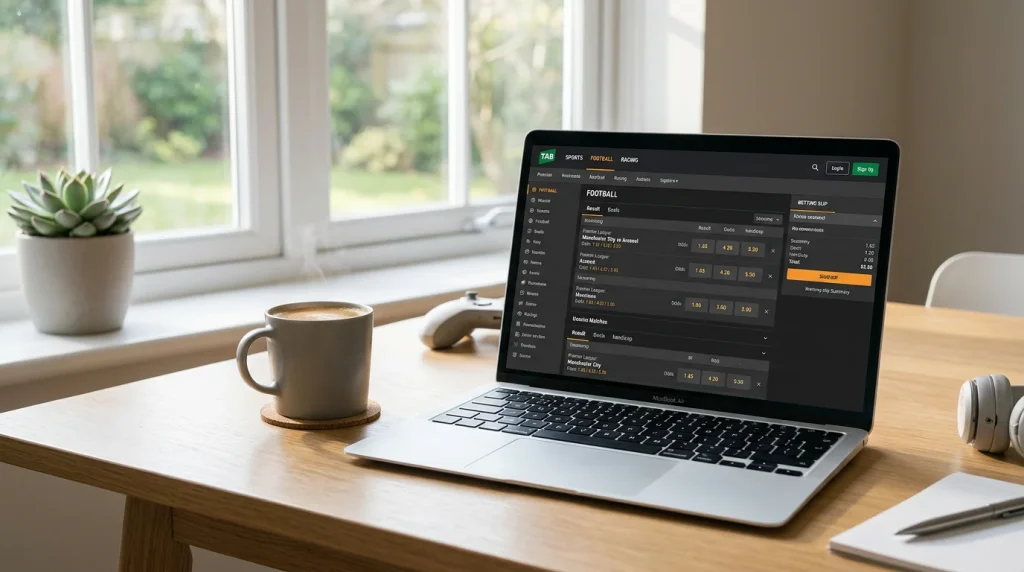
The bet slip accumulates your selections before you confirm any wager. Adding a selection — say, New Zealand +1.5 Asian handicap — places it in the bet slip without committing your stake. You can build multi-bet accumulators by adding additional selections, each appearing in the slip with current odds. The interface calculates potential returns based on your stake input across singles, doubles, trebles, or full accumulators.
Odds display in decimal format throughout TAB NZ’s platform. This differs from fractional odds common in the UK or American odds used in the United States. Decimal odds show total return including stake — 2.50 means a $10 bet returns $25 total ($15 profit plus $10 stake). The platform won’t convert to other formats, so understanding decimal odds is essential for New Zealand punters.
Live betting sections activate once matches begin. The interface shifts to highlight in-play markets with odds updating as match situations change. Available markets during live betting are typically fewer than pre-match, focusing on next goal, match result, and total goals. Odds movement during live play can be rapid, and selections may become unavailable momentarily during goals or other significant events while bookmakers reassess probabilities.
Understanding Decimal Odds and Returns
A punter I know once placed a bet thinking he’d profit $150 on a $100 stake at odds of 1.50. He was genuinely confused when the return was only $150 total — $50 profit plus his $100 stake back. That confusion stemmed from misunderstanding what decimal odds actually represent. Getting this right before the World Cup prevents similar disappointments.
Decimal odds express total return per unit staked. When TAB NZ shows Belgium at 1.65 to beat New Zealand, they’re saying every dollar wagered returns $1.65 if Belgium wins. Your profit is 65 cents per dollar — the $1.65 return minus your $1 stake. This straightforward multiplication makes calculating potential returns simple: stake multiplied by decimal odds equals total return.
Converting decimal odds to implied probability reveals what the bookmaker believes about likely outcomes. The formula divides 1 by the decimal odds. Belgium at 1.65 implies 1 ÷ 1.65 = 0.606, or approximately 60.6% probability. TAB NZ’s odds-setters believe Belgium has about a 60% chance of beating New Zealand in that hypothetical market.
The sum of implied probabilities across a market reveals the bookmaker’s margin. For a match result market (three outcomes), true probabilities would total exactly 100%. If Belgium is 1.65 (60.6%), draw is 3.80 (26.3%), and New Zealand is 6.00 (16.7%), the total reaches 103.6%. That extra 3.6% represents TAB NZ’s built-in edge — their profit margin regardless of outcome.
Shorter odds (closer to 1.00) indicate higher probability events. Odds of 1.10 imply 90.9% likelihood — almost certain according to the bookmaker. Longer odds reflect lower probability. New Zealand at 1001.00 to win the World Cup implies 0.1% chance, effectively recognising the possibility while pricing it as extremely unlikely.
Calculating break-even probability helps assess value. At odds of 2.50, you need to win 40% of the time to break even (1 ÷ 2.50 = 0.40). If your analysis suggests a 50% winning probability, the bet offers positive expected value despite losing roughly half the time. This framework — comparing your assessed probability to break-even requirements — underpins profitable betting approaches.
Multi-bet odds multiply each selection’s decimal odds together. A three-leg accumulator on Belgium (1.65), Egypt (2.20), and France (1.45) calculates as 1.65 × 2.20 × 1.45 = 5.27. A $10 stake on this accumulator returns $52.70 if all three selections win, but returns nothing if any single selection loses. The attractively high returns reflect the compounded difficulty of predicting multiple independent outcomes correctly.
Understanding odds movement helps time your bets. When money flows onto a selection, bookmakers shorten the odds to balance their liability. New Zealand might open at 6.00 for a match, drift to 6.50 if early money backs their opponents, then potentially shorten to 5.50 if patriotic Kiwi money arrives closer to kickoff. Tracking these movements reveals where public and sharp money is flowing.
World Cup Market Types Explained
My approach to World Cup betting evolved significantly when I stopped viewing markets as simply “picking winners” and started seeing them as questions the bookmaker asks — each with different risk profiles and edge potential. The market type you choose shapes your betting experience as much as the selections themselves.
Tournament outright markets cover the entire competition. The headline market — tournament winner — asks which team lifts the trophy on July 19, 2026. Related markets include “to reach final,” “to reach semi-finals,” “group winner,” and “to be eliminated in group stage.” These markets open months before kickoff and remain available throughout, with odds adjusting based on results and tournament dynamics.
Group betting focuses specifically on the pool stage. Beyond predicting group winners, markets include exact group standings, whether specific teams qualify for knockout rounds, and head-to-head matchups between group opponents. For New Zealand in Group G, markets might ask whether the All Whites finish above or below Egypt, independent of either team’s overall position.
Match result (1X2) is the fundamental market for individual fixtures. The designation refers to home win (1), draw (X), and away win (2), though World Cup matches on neutral grounds don’t have true home teams — the first-listed team takes the “1” designation. This market settles after 90 minutes plus injury time, excluding extra time and penalties in knockout rounds.
Asian handicap betting applies virtual goal advantages or deficits. If New Zealand receives +1.5 against Belgium, they need only avoid losing by two or more goals. This handicap converts a potential Belgium-dominated fixture into a more balanced betting proposition. Half-goal handicaps (like +1.5 or -0.5) can’t result in pushes, while whole-goal handicaps (+1 or -1) return stakes if the match lands exactly on the line.
Total goals markets bet on combined scoring regardless of which team scores. The standard line is 2.5 goals — betting “over” requires three or more total goals, while “under” wins with two or fewer. Alternative lines at 1.5, 3.5, or even higher exist for matches where expectations differ from the standard. Team-specific total goals markets focus on one side’s scoring output rather than the combined total.
Both teams to score (BTTS) asks simply whether each side finds the net during 90 minutes. This market ignores scoreline, match result, and goal totals. New Zealand versus Iran could finish 1-1 (BTTS yes) or 3-0 to Iran (BTTS no). The market appeals to punters who have opinions about attacking competence without wanting to predict outright winners.
Goalscorer markets focus on individual players. Anytime goalscorer wins if your selection scores at any point in regulation time. First goalscorer requires opening the scoring and typically offers longer odds. Last goalscorer, to score a brace (two goals), and to score a hat-trick provide additional options with escalating difficulty and returns. Chris Wood anytime goalscorer markets will attract significant New Zealand interest.
Correct score betting predicts the exact final scoreline. This high-risk, high-reward market offers attractive odds but demands precise prediction. Common scorelines like 1-0, 2-1, and 1-1 offer shorter prices than unusual results like 4-3 or 0-0. The difficulty makes correct score markets more suitable for small stakes seeking large returns rather than consistent value betting.
Specials and props cover everything outside standard markets. Tournament top scorer, team to receive most cards, fastest goal, highest-scoring match, and countless other creative markets appear during World Cups. These often carry higher margins due to lower liquidity, but occasionally present value when bookmakers price novel markets without extensive historical data.
Placing Your First World Cup Bet
The moment of actually placing a bet carries unexpected weight for newcomers. I’ve watched confident people hesitate with their finger hovering over “Confirm,” suddenly uncertain about a selection they’d discussed enthusiastically for hours. Walking through the mechanical process in advance reduces that hesitation when real money enters the equation.
Begin by logging into your verified TAB NZ account with sufficient funds deposited. Navigate to the World Cup section through Sports > Football > FIFA World Cup 2026. If you’re betting on a specific match, find that fixture. If you’re placing an outright wager, locate the tournament-long markets section instead.
Select your market by clicking on the odds. For example, if you want to back New Zealand to beat Iran, click on the odds displayed next to “New Zealand” in the match result market. This action adds the selection to your bet slip — it doesn’t commit you to anything yet. The bet slip typically appears as a panel on the right side of desktop interfaces or as a tab/drawer on mobile.
Review the selection in your bet slip before proceeding. Confirm the market is correct (match result, not Asian handicap or another market), the selection matches your intention (New Zealand, not Iran), and the odds shown are acceptable. Odds can change between clicking and confirming, particularly for live betting or when significant money moves the market.
Enter your stake amount in the designated field. The bet slip will calculate and display your potential return based on the current odds. A $20 stake at odds of 3.40 shows a potential return of $68 ($48 profit plus $20 stake). Ensure the stake doesn’t exceed your pre-set limits or your available account balance.
Check for promotions or odds boosts before confirming. TAB NZ occasionally offers enhanced odds on selected markets, particularly during major tournaments. These promotions typically require opt-in or have maximum stake limits. Applying an available promotion happens before confirmation, not after the bet is placed.
Confirm the bet by clicking the final submission button. The interface typically asks for confirmation, showing a summary of selection, stake, and potential return. Once confirmed, the bet is placed and funds are deducted from your account. You’ll receive confirmation, usually with a bet ID number that allows you to track the wager in your account history.
Record the bet for your own records. Note the selection, odds, stake, date, and your reasoning. This practice enables post-tournament review of what worked and what didn’t. Without records, memory tends to favour winners and forget losers, preventing honest assessment of your betting performance.
Building Accumulators and Multi-Bets
The appeal of accumulators is undeniable — small stakes potentially returning large sums create the dream scenario every punter imagines. But I’ve watched too many nine-leg accumulators fall on the final selection to view them without healthy scepticism about their role in sustainable betting approaches.
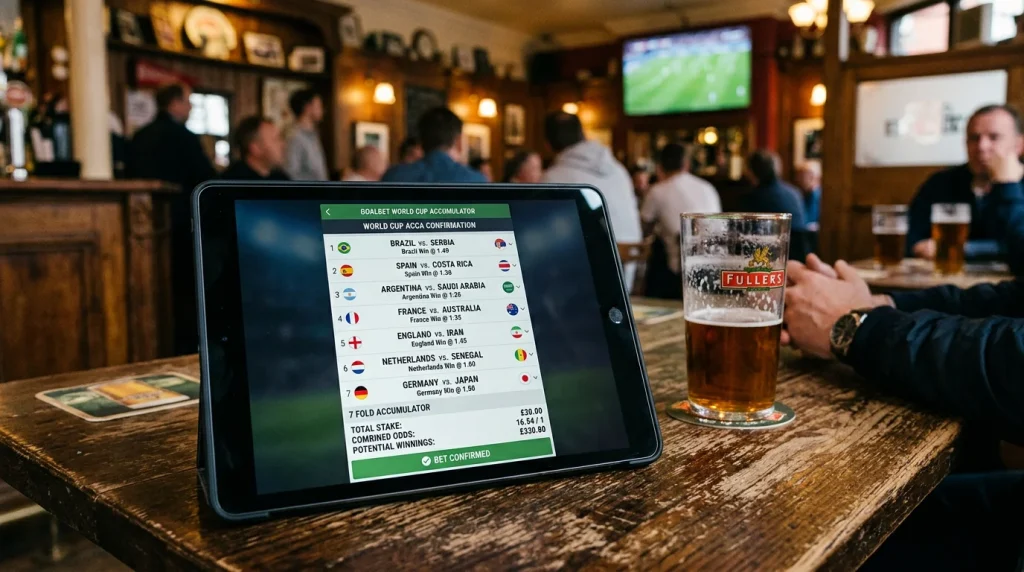
Multi-bets combine multiple selections into a single wager where all legs must win for any return. Adding New Zealand to beat Iran, Egypt to beat New Zealand, and Belgium to beat Egypt creates a three-leg accumulator. Each selection’s odds multiply together, creating combined odds higher than any individual selection offers.
The mathematical trap lies in compounding bookmaker margins. Each leg of an accumulator carries the bookmaker’s edge — typically 3-8% for standard World Cup markets. A three-leg accumulator compounds this edge three times, meaning you’re fighting significantly worse value than three independent single bets would provide. The exciting potential returns mask this structural disadvantage.
Same-game multi-bets combine selections from a single fixture. Backing New Zealand to win, under 2.5 goals, and Chris Wood to score creates a same-game parlay for one match. These bets require all components to succeed — if Wood scores in a 3-2 New Zealand win, the under 2.5 goals leg loses, and the entire bet fails. Bookmakers offer these combinations with adjusted odds reflecting correlated outcomes.
Bankroll impact from accumulators often exceeds single bets despite smaller stakes. The psychological pattern of “just $5 on this eight-leg” repeated across multiple days can exceed what you’d spend on thoughtful single selections. The small individual stakes create false comfort while the accumulation erodes bankroll as quickly as larger individual wagers.
Strategic accumulator use focuses on short combinations with genuine value. Two or three-leg parlays combining high-confidence selections offer reasonable risk-reward balance. The potential returns aren’t spectacular, but the probability of success remains meaningful. Beyond three legs, the compounding probability of loss makes positive expected value increasingly difficult to achieve.
Hedging opportunities occasionally arise mid-accumulator. If two legs of a three-leg parlay have won and the final leg involves a large potential return, placing a separate bet against your final selection can guarantee profit regardless of outcome. This practice locks in smaller returns but eliminates the possibility of zero return after coming so close to full success.
Using accumulators for entertainment rather than profit reframes expectations appropriately. A $10 accumulator across eight World Cup matches provides engagement with multiple fixtures throughout a day. If it loses — which it probably will — you’ve paid $10 for hours of intensified viewing experience. Viewing this as entertainment cost rather than investment expectation prevents frustration when mathematical reality asserts itself.
Live Betting During World Cup Matches
Nothing accelerates a heart rate quite like in-play betting with money on the line. I’ve made brilliant live bets reading match flow correctly, and I’ve made catastrophic ones chasing losses as time ran out. The intensity of live World Cup betting demands specific preparation that pre-match wagering doesn’t require.
Live betting markets activate at kickoff and adjust continuously throughout 90 minutes. TAB NZ’s in-play interface shows current match status, scoreline, and time elapsed alongside shifting odds. Markets suspend momentarily during goals, penalties, and other significant events while bookmakers reassess probabilities. This suspension prevents opportunistic betting on outcomes already determined but not yet reflected in odds.
Available markets during live play narrow from pre-match offerings. Match result, next goal, and total goals remain available throughout. Goalscorer markets may close as the match progresses. Specific markets like correct score often suspend earlier. The limitations reflect both practical considerations (pricing difficulty) and reduced time remaining for outcomes to materialise.
Odds movement velocity in live betting exceeds pre-match fluctuation significantly. A pre-match drift from 2.50 to 2.60 might occur over hours. Live odds can swing from 2.50 to 1.80 within minutes based on match events and betting volume. This volatility creates opportunity for those reading matches well and danger for those reacting emotionally to short-term fluctuation.
Cash-out options allow closing positions before match conclusion. If you’ve bet on New Zealand and they lead 1-0 after 60 minutes, the cash-out offer locks in profit at a reduced level compared to waiting for full-time. The bookmaker offers cash-out because the price guarantees them margin — your decision depends on whether the security of certain profit outweighs potential additional returns or loss reversal.
Watching matches you’re betting on creates psychological pressures absent from pre-match wagering. Every attack seems more dangerous, every defensive mistake more significant when money rides on outcomes. This perceptual distortion can lead to impulsive in-play bets based on emotional reaction rather than genuine probability reassessment. Some punters deliberately avoid watching matches they’ve bet on to prevent this dynamic.
Latency and interface delays affect live betting execution. Between deciding to bet, clicking the selection, entering stake, and confirming, odds may change. TAB NZ’s platform indicates when displayed odds have shifted, but during rapidly moving matches, you might face choice between accepting new odds or cancelling. Fast-moving matches like those involving attacking teams create more frequent price changes than defensive encounters.
Pre-set live betting rules protect against impulsive decisions. Determining maximum in-play stake before kickoff, identifying specific scenarios that warrant betting, and setting loss limits per match creates boundaries. Without these predetermined guidelines, the excitement of live betting easily overwhelms careful analysis, leading to decisions you’d never make in calmer pre-match moments.
Managing Your Betting Bankroll
The single most important conversation I never had before my early betting years was about bankroll management. Nobody explained that winning bets mean nothing if poor staking decisions erode overall position. Learning this lesson through painful experience cost money that proper preparation would have preserved.
Establish a dedicated World Cup betting bankroll separate from your general finances. This amount represents money you can lose entirely without affecting rent, bills, relationships, or mental health. If that figure is zero, enjoying the tournament as a spectator provides genuine pleasure without financial stress. Betting should enhance entertainment, not create anxiety that detracts from the football itself.
Standard staking advice recommends 1-3% of bankroll per bet. With a $500 World Cup bankroll, this means $5-15 per wager. This sizing allows 30+ bets before significant drawdown threatens your entire stake. The conservative approach acknowledges that even well-researched selections lose frequently — World Cup variance is substantial, and losing runs happen to everyone.
Flat staking applies identical amounts to every bet regardless of perceived confidence. This approach removes the temptation to “max bet” on supposedly certain outcomes, which invariably include losers. Variable staking adjusts amounts based on edge assessment — perhaps 1% for standard plays and 3% for high-conviction spots — but requires honest self-assessment of when perceived confidence reflects genuine probability advantage.
Tracking wins and losses prevents the selective memory that makes losing punters think they’re winning. Simple spreadsheets recording each bet, stake, odds, and outcome reveal true performance. Without records, the excitement of winners overshadows the steady drip of losers, creating false confidence about betting skill. Honest records enable honest assessment.
Loss limits per day and for the entire tournament create automatic stops. Deciding in advance that you’ll stop betting after losing $50 in one day, or $200 across the tournament, removes emotional decision-making during difficult stretches. These limits aren’t admission of failure — they’re recognition that even sound strategy encounters variance requiring protection.
Deposit limit settings within TAB NZ enforce boundaries you set. Establishing these limits during account creation, then leaving them unchanged during the tournament, prevents “just one more deposit” decisions after losing runs. The cooling-off period required to increase limits serves this exact protective function — creating time for rational assessment before adding funds.
Winning requires understanding that profitable bettors still lose frequently. A 55% win rate at average odds of 2.00 produces long-term profit, but includes substantial losing periods. Expecting to win every bet, or even most bets, creates frustration that leads to poor decisions. Accepting losses as inevitable while maintaining discipline produces better outcomes than unrealistic expectations.
Responsible Gambling and Support Resources
A close friend developed gambling problems that took years to address. Watching someone intelligent and capable lose control over something that should be entertainment changed how I approach discussing this topic. Responsible gambling isn’t regulatory box-ticking — it’s genuine protection for real people in our communities.
Problem gambling affects approximately 0.3-0.5% of New Zealand’s adult population, with another 2-3% experiencing moderate gambling-related harm. These statistics represent thousands of Kiwis whose relationships, finances, and mental health suffer from gambling that’s moved beyond entertainment. World Cup excitement can intensify these patterns for those already vulnerable.
Warning signs include betting more than you can afford, chasing losses with increasingly large or risky bets, lying about gambling to friends or family, borrowing money to gamble, and feeling anxious or irritable when not gambling. These patterns can develop gradually, making self-recognition difficult. Honest reflection about whether these descriptions fit your behaviour — especially as tournament excitement builds — matters more than external observation.
TAB NZ provides mandatory responsible gambling tools. Deposit limits cap how much you can add to your account across daily, weekly, or monthly periods. Take-a-break options suspend account access for 24 hours to seven days. Self-exclusion removes betting access entirely for minimum six months, with national self-exclusion available across all New Zealand gambling venues.
The Gambling Helpline at 0800 654 655 provides confidential support from trained counsellors. This service operates free of charge, funded through gambling levies. Calling doesn’t commit you to anything — it provides opportunity to discuss concerns with someone experienced in helping people assess and address gambling-related issues.
Online resources including choicenotchance.org.nz offer information about gambling harm and self-assessment tools. These resources help identify whether your gambling patterns fall within recreational norms or show concerning characteristics. Early intervention produces better outcomes than waiting until problems become severe.
Family and friends of problem gamblers also have support options. The Gambling Helpline provides guidance for those affected by someone else’s gambling. Understanding that problem gambling affects more than the individual gambler — it impacts families, relationships, and financial stability of interconnected households — contextualises why responsible gambling provisions exist.
For the majority of punters who gamble recreationally without problems, these resources remain available if circumstances change. The World Cup’s intensity, the emotional investment in All Whites matches, and the constant availability of betting options creates an environment where previously controlled gambling can escalate. Knowing support exists before you need it is prudent rather than paranoid.
Making the Most of World Cup 2026 Betting
Eight years covering betting markets taught me that the best experiences combine informed wagering with genuine appreciation for the sport itself. The World Cup offers both — extraordinary football featuring our All Whites, alongside betting opportunities that can enhance engagement when approached thoughtfully.
Your preparation in the months before June 2026 shapes your tournament experience. Setting up your TAB NZ account now avoids last-minute registration when you’re eager to bet on the opening match. Establishing your bankroll and staking approach removes decision-making pressure once action begins. Familiarising yourself with the betting interface prevents confusion when navigating markets during live fixtures.
For the All Whites specifically, betting adds dimension to already emotionally significant matches. Chris Wood’s fitness updates, squad selections, and tactical approaches all carry implications beyond supporting the team — they inform betting decisions that make you a more engaged observer. Whether that additional engagement improves or detracts from your experience depends entirely on how you structure your approach.
The information in this guide provides foundation, but application requires ongoing judgment. Odds change, circumstances shift, and tournament dynamics evolve across 39 days of football. Your framework for approaching World Cup 2026 betting should be firm on principles — bankroll limits, legal compliance, responsible gambling — while remaining flexible on specific selections as information develops.
New Zealand punters have a unique opportunity at this World Cup. Our team competing, matches at accessible viewing times for NZST/NZDT, legal betting infrastructure in place, and an expanded tournament format that gives smaller nations genuine advancement pathways. How you engage with betting during this tournament is entirely your choice — but having the knowledge to make that choice informed is what this guide aimed to provide.
