
Brazil at World Cup 2026: Seleção’s Quest for Six
 Available in US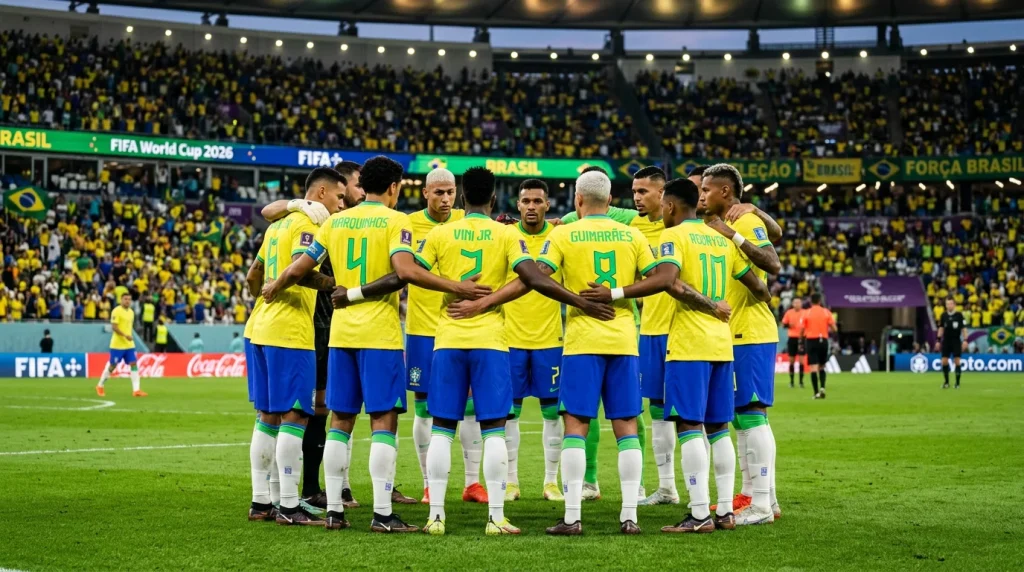
Table of Contents
Twenty-four years without a World Cup title weighs heavily on Brazilian football. I covered their 2022 quarter-final exit to Croatia in Qatar, watching Neymar score a magnificent extra-time goal only for penalty heartbreak to follow. The tears that night reflected accumulated frustration across two decades — five World Cups producing three quarter-final exits, one semi-final humiliation, and one fourth-place finish, but never the trophy Brazil considers their birthright. The Seleção at World Cup 2026 arrive in North America with a new generation of attackers, a settled tactical approach, and desperation to restore Brazil’s standing as football’s preeminent nation. For Kiwi punters analysing tournament markets, Brazil represent both perennial favourites and value propositions, depending on how you interpret their recent struggles against European opposition.
Brazil’s squad for 2026 features Vinícius Jr as the undisputed talisman — a transition that seemed inevitable once Neymar’s injuries accumulated beyond recovery. The Real Madrid winger has ascended to football’s absolute elite, winning the Ballon d’Or in 2024 and backing it up with consistent performances that justify the individual accolade. Around Vinícius, Brazil deploy Rodrygo, Raphinha, and Endrick — attacking talent that excites neutral observers while concerning pragmatic analysts who note the defensive vulnerabilities this wealth of forwards can create.
CONMEBOL Qualification: Brazil’s Path
South American qualification nearly produced the unthinkable. Brazil finished fifth in CONMEBOL standings, scraping into automatic qualification on goal difference ahead of Colombia while Argentina and Uruguay dominated above them. The campaign included home defeats to Argentina and Uruguay, humiliating results that triggered coaching changes and national soul-searching. Brazil qualified for their 23rd consecutive World Cup, but the manner raised genuine questions about whether this generation could compete when tournament pressure intensifies.
Coach Dorival Júnior inherited chaos and imposed order through defensive reorganisation. His predecessor had prioritised attacking expression at the expense of structural security; Dorival restored balance by demanding positional discipline from midfielders and committing to defensive transitions that actually involved forwards tracking back. The results improved immediately — Brazil’s final eight qualifying matches produced five wins and only one defeat, sufficient to secure their berth despite the catastrophic early campaign.
Vinícius scored nine goals across qualification, establishing himself as Brazil’s primary attacking threat and taking ownership of the number 10 role that Neymar vacated through injury absence. His willingness to accept responsibility in crucial moments contrasted favourably with earlier generations where Neymar’s presence created dependency. Brazil now build around Vinícius rather than praying for Neymar’s health — a healthier dynamic even if total individual quality diminished slightly.
Defensive concerns persist despite Dorival’s improvements. Brazil conceded 15 goals across 18 qualifying matches — 0.83 per game — inferior to their historical standards. The centre-back combinations experimented during qualification never found consistency, with Marquinhos approaching career twilight while potential successors failed to convince. This vulnerability will be exploited by European opponents deploying clinical forwards at the World Cup.
Vinícius, Rodrygo, and Brazil’s Stars
Vinícius Jr operates at a level that few footballers in history have reached during their mid-twenties. His dribbling ability, acceleration, and finishing have produced over 25 goals per season across the past three campaigns at Real Madrid, numbers that place him among the world’s elite regardless of position. Vinícius has developed from raw talent into complete attacker — his defensive work rate improved dramatically under Carlo Ancelotti’s guidance, and his decision-making in the final third now matches his physical gifts.
The criticism that follows Vinícius involves consistency at international level. His Brazil performances have not matched Real Madrid production, partly because different tactical systems limit his freedom and partly because opponents specifically target neutralising him. World Cup 2026 represents his opportunity to silence doubters by delivering on football’s grandest stage. His Ballon d’Or status demands tournament success; individual awards mean little without major trophies for the national team that Brazilians care most about.
Rodrygo provides the ideal complement to Vinícius, offering right-sided threat that prevents opponents from overloading defensively against Brazilian attacks. His technical quality matches Vinícius without the explosive pace, instead relying on intelligent movement and clinical finishing from central positions. Rodrygo’s Champions League experience — including decisive goals in multiple knockout rounds — demonstrates composure under pressure that transfers to World Cup intensity.
Raphinha brings Premier League experience from Barcelona and previously Leeds United, operating across the forward line with versatility that creates selection options. His work rate satisfies coaches who demand defensive contribution from attackers, while his crossing and shooting from wide areas threaten opponents differently than Vinícius’s direct dribbling. Raphinha’s international record includes crucial goals during qualification that earned him a guaranteed starting role.
Endrick represents Brazil’s future arriving early. The teenager signed for Real Madrid as the most hyped Brazilian prospect since Neymar emerged at Santos, and early performances suggest the hype might actually understate his potential. Endrick’s power, pace, and finishing instincts create natural goalscoring threat that Brazil have lacked since Ronaldo’s prime. Using him wisely at the World Cup involves managing expectations while recognising that teenage strikers occasionally produce tournament-defining moments.
In midfield, Bruno Guimarães provides the anchor that allows Brazilian attackers freedom. His positioning, passing range, and ability to break up opposition attacks has made him one of the Premier League’s premier midfielders. Guimarães transforms Brazilian defensive stability simply through his presence, organising teammates and winning possession in crucial areas.
Group C: Morocco, Scotland, Haiti
Brazil landed relatively gently in Group C, avoiding the genuinely difficult draws that befell some European heavyweights. Morocco represent the primary threat following their extraordinary 2022 World Cup run to the semi-finals. Scotland bring British organisation and physical challenge. Haiti complete the group as significant underdogs but potential banana skin if Brazil approach their fixture carelessly.
Morocco demand respect after eliminating Belgium, Spain, and Portugal in Qatar. The Atlas Lions proved that defensive organisation and counterattacking threat can neutralise technically superior opponents across 90 minutes. Achraf Hakimi, Sofiane Amrabat, and a core of players now established at elite European clubs means Morocco have retained their 2022 quality while adding experience. Brazil versus Morocco on June 15 in San Francisco represents a genuine contest rather than foregone conclusion.
Scotland qualified through UEFA’s demanding pathway, defeating Spain along the way to prove their credentials against elite opposition. Steve Clarke’s team prioritise defensive structure and set-piece threat, creating problems for opponents who expect Scottish submissions against superior technical quality. Brazil historically struggle against physical, organised European opponents — Scotland fit that profile precisely.
Haiti qualified as CONCACAF’s surprise package, defeating Mexico in the final qualifying round to secure their berth. The Haitians lack the squad depth to threaten Brazil across 90 minutes, but they possess players who can produce individual moments of brilliance. Brazil’s final group match against Haiti should provide comfortable victory and goal difference accumulation, though complacency could generate embarrassment.
Bookmakers price Brazil around 1.20 to win Group C, with Morocco their only realistic challenger for top spot. These odds compress value significantly — Brazilian group victory offers minimal return against genuine risk that Morocco upset the order. More interesting angles involve Brazil’s exact finishing position or match-specific bets against Morocco.
Brazil’s New Era: Post-Neymar
Neymar’s absence from World Cup 2026 through ongoing injury complications closes a chapter of Brazilian football that never quite fulfilled its promise. The Paris Saint-Germain and Al-Hilal forward won everything at club level without delivering the World Cup trophy Brazil craved. His injuries during crucial tournament moments — 2014 back fracture, 2022 ankle problems — created narratives about what might have been rather than what actually occurred.
The post-Neymar era requires Brazil to function as a unit rather than depending on individual magic. Vinícius provides star quality, but Dorival’s system distributes creative responsibility across multiple attackers rather than channeling everything through one playmaker. This approach mirrors how France operated without relying solely on Mbappé or how England utilise multiple threats rather than Harry Kane isolation plays.
Tactically, Brazil under Dorival operate in a 4-2-3-1 that becomes 4-4-2 defensively. Vinícius and Raphinha tuck inside during defensive phases, creating compact midfield blocks that protect centre-backs. In possession, fullbacks provide width while Vinícius roams seeking one-on-one opportunities against isolated defenders. The system balances Brazilian attacking traditions with modern defensive demands — a compromise that sacrifices some flair for competitive functionality.
The emotional transition matters as much as the tactical one. Brazil teams featuring Neymar sometimes fractured when adversity struck, with blame directed toward the star and his perceived attitude. Vinícius commands different respect — his work rate cannot be questioned, and his leadership involves example rather than personality. Whether this cultural shift produces tournament success remains uncertain, but the atmosphere surrounding Brazilian football feels healthier than during Neymar’s frustrating tenure as national captain.
Brazil World Cup 2026 Betting Odds and Markets
Brazil sit around 8.00 to win the World Cup outright — shorter than England, longer than France and Argentina. These odds reflect bookmaker assessment that Brazil possess sufficient quality to win but face competition from multiple nations with stronger recent tournament pedigrees. The implied probability of approximately 12.5% feels about right for a team that could lift the trophy or exit in the quarter-finals depending on draw and form.
Value in Brazilian markets requires identifying specific scenarios where your assessment diverges from consensus. Backing Brazil to reach the semi-finals offers better returns than outright markets while acknowledging their likely advancement through early knockout rounds. Conversely, backing Brazil to exit before the quarter-finals provides value for those believing their defensive vulnerabilities will be exposed against elite European attackers.
Vinícius Jr leads Brazilian individual markets across goalscoring categories. His Golden Boot odds around 12.00 acknowledge both his quality and Brazil’s potential tournament longevity — to win the award, Brazil likely need to reach at least semi-finals while Vinícius maintains health and form. His anytime scorer prices in individual matches should consistently offer value given his output relative to opponents’ defensive quality.
Brazil’s matches typically produce goals at both ends. Both teams to score markets suit their profile — Brazilian attacking quality threatens anyone while their defensive vulnerabilities allow opponents opportunities. Over 2.5 goals in Brazil fixtures should price attractively across the tournament, with the Morocco match potentially producing the lowest total given Moroccan defensive discipline.
Corners markets favour Brazil heavily. They average over seven corners per match in competitive fixtures, driven by attacking pressure that forces clearances and recovered possession in advanced areas. Brazil corner counts against Haiti could approach double figures if the match unfolds as expected.
World Cup History: The Five-Time Champions
Brazil remain football’s only five-time World Cup winners, a distinction that shapes national identity and international expectations. Their 2002 triumph in Japan/South Korea featured Ronaldo’s redemption, Rivaldo’s brilliance, and Ronaldinho’s emergence — the last hurrah for a generation that defined attacking football. Twenty-four years later, that trophy feels increasingly distant as Brazil’s drought extends beyond any reasonable expectation.
The 2014 World Cup semi-final defeat to Germany — 7-1 on home soil — remains Brazilian football’s darkest moment. That scoreline traumatised a nation that expected their World Cup hosting to culminate in glory. Instead, Germany exposed defensive fragility so comprehensively that the defeat transcended sport into national humiliation. Every Brazilian squad since carries that memory, either as motivation or burden depending on psychological perspective.
Since 2002, Brazil have reached one World Cup final — losing to France in 2006 — and four quarter-finals where European opponents eliminated them three times. The pattern suggests Brazilian football has fallen behind European tactical development without finding compensating advantages. Individual brilliance that once overwhelmed opponents no longer guarantees tournament success against organised, athletic European squads.
Historical context informs realistic expectation: Brazil can absolutely win World Cup 2026, but they have not demonstrated consistent ability to defeat elite European opposition in knockout settings. Their tournament ceiling depends on draw, form, and whether Vinícius produces performances matching his club-level dominance.
Can Brazil End the 24-Year Wait?
Brazil possess the attacking quality to score against any opponent and the defensive vulnerabilities to concede against most. This duality creates tournament outcomes that swing between glory and frustration, sometimes within the same match. The quarter-final exit pattern — competitive but ultimately insufficient — represents Brazil’s most likely outcome unless something fundamentally changes.
What could change everything involves Vinícius reaching a performance level that transcends normal tournament football. Maradona in 1986, Ronaldo in 2002, Mbappé approaching such heights in 2022 — these individual eruptions carry nations beyond their collective capabilities. Vinícius has the talent; whether he has the temperament for tournament transcendence remains unproven.
Dorival’s tactical organisation provides better defensive foundation than previous Brazilian coaches managed, but “better” still means “vulnerable” when facing clinical European forwards. Brazil need fortune with injuries, favourable draws, and moments of magic from their considerable attacking talent. The 24-year wait could end in July 2026. It could also extend to 2030 and beyond if quarterfinal demons return.
For Kiwi punters, Brazil offer entertainment value across numerous markets without representing the tournament’s clearest betting propositions. Back them for knockouts advancement with confidence; approach outright and deep-run markets with appropriate caution. Brazil will score goals, concede some, and produce drama regardless of ultimate outcome. Whether that drama concludes with trophy celebration or tearful elimination remains gloriously uncertain.
