
Group G Preview: All Whites’ World Cup Battleground
 Available in US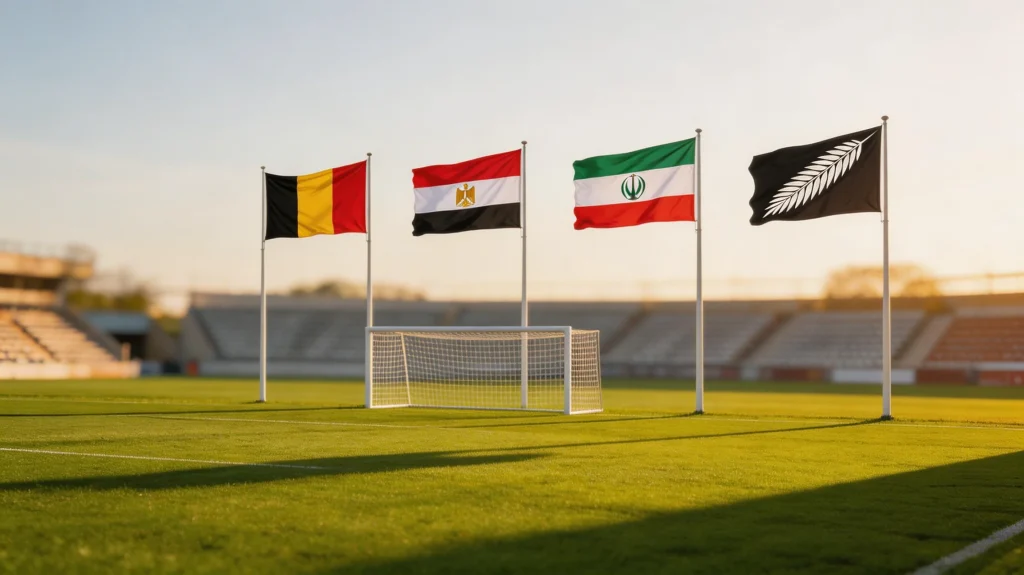
Table of Contents
When the final ball dropped into pot four during the December 2025 draw in Zurich, I watched with a mixture of dread and strange optimism. Belgium. Egypt. Iran. These are the names that will define New Zealand football for the next generation. Group G at World Cup 2026 represents the most significant competitive challenge our All Whites have faced since that unforgettable night in Mexico City when we held Italy to a draw in 2010. The draw handed us a group with a clear favourite, two beatable opponents, and enough mathematical pathways to make advancement genuinely possible rather than merely aspirational.
Group G World Cup 2026 sits in that fascinating middle ground between death group and gentle draw. Belgium’s golden generation enters potentially their final major tournament together. Egypt brings Mohamed Salah and the weight of 100 million fans. Iran returns with their characteristic defensive discipline and counter-attacking threat. And then there’s us — ranked 93rd, representing a nation of five million, carrying dreams that seemed impossible just eighteen months ago. The expanded 48-team format with third-place qualification changes everything about how we approach this group, and understanding each opponent’s strengths, vulnerabilities, and likely tactics shapes both expectations and betting opportunities.
Belgium: The Favourites Carrying Unfulfilled Promise
I remember watching Kevin De Bruyne orchestrate Belgium’s 2018 World Cup campaign from a cramped Auckland bar, thinking they were destined for the trophy. They finished third. In 2022, the golden generation stumbled out in the group stage, beaten by Morocco and unable to break down Croatia. Now they arrive at potentially their last dance, and the pressure of unfulfilled potential weighs heavier than any opponent they’ll face in Group G.
Belgium’s squad remains formidable despite the aging core that has defined their identity for a decade. De Bruyne at 35 continues dictating play for Manchester City with the precision that makes him arguably the world’s finest playmaker. Romelu Lukaku’s finishing instincts have survived club-level turbulence; his international record of 85 goals in 115 appearances speaks to effectiveness that transcends form fluctuations. Jeremy Doku’s emergence provides the pace and directness the older creative players sometimes lack, while Amadou Onana anchors a midfield that can control possession against almost any opponent.
The concerns for Belgium centre on defensive vulnerability and the psychological burden of expectation. Their back line has never matched their attacking quality — Jan Vertonghen and Toby Alderweireld defined an era but time waits for no defender. The current options lack the same authority, and teams willing to press Belgium’s build-up can create problems their midfield creativity cannot always solve. Against defensive-minded opponents content to absorb pressure and strike on transitions, Belgium sometimes struggle to find the breakthrough their talent suggests should be automatic.
For betting purposes, Belgium at approximately 1.35 to win Group G represents fair value but limited upside. Their odds to beat New Zealand will likely sit around 1.25-1.30, reflecting overwhelming favouritism that leaves little room for profitable backing. The more interesting markets involve Belgium’s margin of victory and whether their aging legs can maintain intensity across three group matches in North American summer conditions. Their path through the group should be comfortable; their knockout stage ceiling remains the persistent question mark hanging over this squad.
Egypt: Salah’s Pharaohs and African Ambition
Every conversation about Egypt begins and ends with Mohamed Salah, and for good reason. His Liverpool brilliance has defined Premier League attacking play for seven seasons, his individual quality capable of deciding matches that team structure cannot. But international football presents different challenges, and Egypt’s World Cup history — three appearances, three group stage exits — suggests the Pharaohs struggle to translate Salah’s genius into collective tournament success.
Egypt qualified through the African pathway that has become increasingly competitive as the continent’s football development accelerates. Their CAF qualification campaign showcased the team’s defensive organisation under coach Rui Vitória, conceding just six goals across twelve matches while Salah’s nine goals provided the attacking punctuation. Omar Marmoush’s breakthrough season with Eintracht Frankfurt adds a secondary creative threat that previous Egyptian squads lacked — his 15 Bundesliga goals in 2024-25 demonstrated finishing quality that complements rather than duplicates Salah’s threat.
The tactical approach Egypt will likely employ centres on defensive compactness and rapid transitions through their star players. Against Belgium, this approach makes sense; against New Zealand, the calculus shifts. Egypt will expect to dominate possession against the All Whites, forcing them into unfamiliar territory where they must create from controlled play rather than counter-attacks. This role reversal could expose Egypt’s limitations in breaking down organised defences, the same vulnerability that plagued their 2018 campaign.
Egypt’s match against New Zealand represents the pivotal fixture for both teams’ advancement hopes. Odds around 2.10 for Egypt to beat New Zealand suggest bookmakers view this as competitive rather than foregone. The draw market at approximately 3.20 may offer value if you believe both teams will approach the match cautiously, aware that a point serves their qualification scenarios better than risking defeat chasing victory. My assessment places Egypt’s realistic group finish at second, though their ceiling is limited by the same Salah-dependency that has defined their tournament football for years.
Iran: Experienced Campaigners with Defensive Steel
Six World Cup appearances tell a story of Iranian football that outsiders rarely appreciate. This is a nation that knows tournament football, understands the stakes, and possesses the tactical discipline to execute defensive game plans that frustrate technically superior opponents. Iran’s 2022 campaign included a stunning 2-0 victory over Wales and a narrow 1-0 loss to the United States that eliminated them on goal difference. They know how to compete at this level, even if breakthrough success remains elusive.
The Iranian squad for 2026 combines experienced campaigners with emerging talent developed in European leagues. Mehdi Taremi’s Inter Milan move proved his quality at the highest club level; his hold-up play and finishing make him the focal point Iran will build their attack around. Sardar Azmoun’s pace on the counter provides the secondary threat that transforms Iran from merely organised to genuinely dangerous. The midfield engine of Saeid Ezatolahi and Ahmad Nourollahi provides the screening that allows Iran’s compact defensive shape to absorb pressure without exposing the back line.
Iran’s opening match against New Zealand at SoFi Stadium carries enormous significance for both teams. For Iran, victory would establish immediate advantage in the battle for potential third-place qualification. For the All Whites, the opener represents the most winnable of their three fixtures — a sentiment that oversimplifies Iran’s quality but reflects genuine tactical opportunity. Iran’s defensive discipline can crack under sustained pressure they’re unaccustomed to absorbing; their preference for controlling matches through defensive structure rather than possession means space can open for teams willing to commit bodies forward.
Betting markets for Iran reflect their status as the group’s third seed. Odds around 2.50 to finish above New Zealand suggest bookmakers rate them clear favourites in the direct comparison, though this pricing potentially undervalues the All Whites’ momentum and motivation. Iran’s tournament experience provides advantage in managing the occasion; their tactical predictability offers preparation clarity that New Zealand’s coaching staff will exploit. The Iran versus New Zealand match deserves careful consideration across multiple markets — match result, goal totals, and first-half betting all present angles worth exploring.
New Zealand: Our All Whites Take the Stage
Sixteen years between World Cups does something to a football nation’s psyche. We’ve watched from afar as other small nations — Iceland, Costa Rica, Wales — captured global attention with tournament runs that seemed impossible until they happened. Now the All Whites return with a squad that lacks the household names of our opponents but carries something equally valuable: collective belief forged through the crucible of qualification. Ryan Thomas and Liberato Cacace might not feature in FIFA rankings discussions, but they represent a generation of Kiwi footballers developed in European leagues who understand professional standards.
Chris Wood’s presence transforms our attacking profile from hopeful to credible. His Premier League consistency with Nottingham Forest provides proven quality at the highest domestic level — something previous All Whites World Cup squads fundamentally lacked. At 34 during the tournament, Wood’s fitness becomes paramount; monitoring his final season months at Forest will provide crucial information for anyone betting on New Zealand’s scoring potential. Behind Wood, the squad offers organisation rather than brilliance, defensive structure rather than individual excellence, and tactical discipline that can make us awkward opponents for teams expecting easy victories.
The All Whites’ path through Group G requires pragmatic assessment. Belgium will likely be too strong regardless of our effort. The Egypt and Iran matches represent genuine competition for points, with the third-place qualification pathway making four points across those two fixtures a realistic advancement threshold. A draw against Iran followed by victory over Egypt represents the optimal scenario; reversing that order — beating Iran and drawing with Egypt — works equally well mathematically while perhaps being more difficult tactically.
TAB NZ offers New Zealand at 2.38 to advance from Group G, implying approximately 42% probability. For those of us who’ve followed this team through qualification, watched them grind out results against Costa Rica in the intercontinental playoff, and witnessed the quality improvements under coach Darren Bazeley, that pricing may undervalue our genuine chances. The All Whites World Cup campaign carries emotional weight that transcends cold probability assessment — though prudent betting requires maintaining that analytical distance even when patriotic passion pulls otherwise.
Group G Schedule: All Match Times in NZT
The World Cup draw delivered unexpectedly favourable timing for New Zealand viewers. Our matches fall during New Zealand afternoon and early evening hours, avoiding the overnight scheduling that plagued previous tournament viewing experiences. The 16-17 hour time difference from US Pacific coast means evening kickoffs in Los Angeles and Vancouver translate to lunch and afternoon starts in Auckland and Wellington.
The All Whites open against Iran on June 16 at SoFi Stadium in Los Angeles. The 6pm local kickoff translates to 1:00 PM NZST the following day — perfect timing for pub viewings and workplace distractions. Five days later, New Zealand faces Egypt at BC Place in Vancouver on June 22, with the same 6pm local start producing another 1:00 PM NZST afternoon fixture. The group concludes against Belgium on June 27 at BC Place, with an 8pm local kickoff pushing the New Zealand time to 3:00 PM NZST.
The broader Group G schedule sees Belgium face Iran in their opener on June 15, Egypt meet Iran on June 21, and Belgium close against Egypt on June 27. These fixtures determine the qualification picture that New Zealand’s results will slot into. Watching Belgium vs Iran before our opener against Iran provides tactical information about Iranian tendencies; Egypt’s performance against Belgium shapes understanding of what we’ll face in our second match. The interconnected nature of group stage football rewards attention to all six fixtures, not merely the three directly involving the All Whites.
For live betting purposes, the afternoon NZST scheduling enables engaged wagering without sleep deprivation. In-play markets during New Zealand matches will attract significant domestic interest, potentially creating inefficiencies as patriotic money flows regardless of match state. Those willing to bet against emotional sentiment — backing Iran if New Zealand takes an early lead they’re unlikely to protect, for example — may find value in the live markets that public money distorts.
Predicted Finish: Who’s Going Through?
My Group G prediction places Belgium first with seven points, Egypt second with four points, Iran third with three points, and New Zealand fourth with two points. This assessment reflects the quality hierarchy while acknowledging the competitive middle tier where small margins determine finishing positions. Belgium should beat everyone; the question is whether they do so comfortably or scrappily. Egypt versus Iran becomes the match that likely determines second place, with their direct encounter carrying outsized importance.
The scenario I’ve outlined sees Belgium win all three matches, Egypt beat Iran and New Zealand while losing to Belgium, Iran draw with New Zealand and lose to Belgium and Egypt, and New Zealand draw with Iran and lose to Egypt and Belgium. This produces a final table of Belgium 9 points, Egypt 6 points, Iran 2 points, New Zealand 1 point. But football rarely follows predicted scripts, and the margins in this group are narrower than the final standings suggest.
Alternative scenarios worth considering include New Zealand beating Iran in the opener, which immediately reshapes the group dynamic. An All Whites victory would place pressure on Iran to beat Egypt — a result that helps New Zealand’s advancement by taking points from direct rivals. The Egypt vs New Zealand match then becomes decisive for both teams, with potential for cautious play if both enter with results that make a draw acceptable. Group G’s qualification mathematics create scenarios where mutual interest in a draw could produce exactly that outcome.
Belgium’s rotation decisions affect the final matchday dynamics significantly. If they’ve secured first place heading into their New Zealand match, manager Domenico Tedesco may rest key players before knockout rounds. A second-string Belgium side remains formidable but presents different challenges than the full-strength version. The All Whites might face either their hardest or easiest match depending on Belgium’s qualification status — another variable that makes pre-tournament predictions inherently uncertain.
Group G Betting Odds
Current Group G winner markets show Belgium at approximately 1.35, Egypt at 5.50, Iran at 12.00, and New Zealand at 26.00. These prices reflect the quality hierarchy while perhaps undervaluing the group’s competitive middle tier. Belgium’s short price offers minimal return for substantial risk if their aging squad falters; the 1.35 odds imply 74% probability of topping the group, which may be slightly generous given their recent tournament struggles.
The group qualification markets present more interesting angles. New Zealand to advance at 2.38 represents the primary market for Kiwi punters, offering better value than outright winner given the third-place qualification pathway. Iran to advance at approximately 1.80 reflects their experience advantage, though the pricing assumes they’ll handle New Zealand comfortably — an assumption their own tournament history doesn’t fully support. Egypt to advance at 1.45 feels appropriate given their quality edge over the group’s bottom half.
Match betting across the six Group G fixtures offers varied opportunities. Belgium matches will attract one-sided action with limited value on either side. The Egypt vs Iran encounter deserves attention as the most unpredictable match in the group, with both teams needing points and neither possessing clear tactical advantage. New Zealand’s matches against Iran and Egypt represent the most interesting markets for value-seeking punters, with draw prices potentially offering edge if you believe conservative approaches will prevail.
Goal market pricing in Group G reflects the defensive profiles of three of four teams. New Zealand, Iran, and Egypt all prioritise defensive organisation; only Belgium consistently commits to attacking football regardless of opponent. Under 2.5 goals may offer value across multiple matches, particularly Iran vs New Zealand where both teams’ natural tendencies favour low-scoring affairs. The Belgium matches should produce more goals, with over 2.5 priced shorter reflecting their attacking intent and the quality gap that forces opponents forward late in matches chasing equalisers.
Qualification Scenarios for New Zealand
The expanded World Cup format fundamentally changes qualification mathematics. With the top two from each group advancing alongside the eight best third-placed teams, New Zealand’s path to the knockout rounds doesn’t require finishing above Egypt or Iran — merely finishing third with enough points and goal difference to rank among the top eight third-place finishers. Historical analysis of similar formats suggests three points typically reaches the eight-team threshold, while four points virtually guarantees advancement.
New Zealand’s most realistic advancement scenario involves beating Iran, drawing with Egypt, and losing to Belgium. This four-point total would likely secure third place in Group G while providing sufficient points for third-place qualification across the tournament. The goal difference accumulated matters significantly — a 1-0 win against Iran and 1-1 draw with Egypt produces neutral goal difference that could prove critical in third-place tiebreakers.
The pessimistic scenario sees New Zealand draw with Iran, lose to Egypt, and lose to Belgium — producing one point that’s insufficient for advancement under any calculation. This outcome seems more likely than the optimistic scenario where we beat both Iran and Egypt, though stranger things have happened in World Cup football. The realistic range for New Zealand’s final points total spans one to four, with two or three points representing the probable landing zone.
For betting purposes, the qualification scenarios create derivative markets worth exploring. New Zealand’s points total over/under markets, if available, present angles for those with strong views on match outcomes. Backing New Zealand in multiple matches through accumulators offers enhanced odds but requires sequential success that compounds difficulty. Single-match betting on the Iran opener may offer the best risk-reward profile — a market where New Zealand’s odds around 3.40 potentially exceed their genuine probability of victory.
Kia Kaha: Into the Group G Battleground
Group G presents exactly the challenge New Zealand football needs at this moment in its development. Belgium provides the aspirational benchmark — the level we hope to eventually approach. Egypt and Iran offer genuine competition where results are possible rather than merely theoretical. The expanded format means advancement is achievable rather than fantasy, transforming three group matches into meaningful contests with genuine stakes.
The All Whites enter this World Cup representing more than themselves. They carry the hopes of a football nation that has waited sixteen years for this opportunity, the dreams of young players who grew up watching the 2010 campaign and now play in European leagues themselves, and the expectations of supporters who understand that success here means reaching the knockout rounds rather than lifting the trophy. Group G determines whether that definition of success proves attainable.
My betting approach for Group G centres on the New Zealand matches where informational advantages may exist. The Iran opener warrants serious consideration at available odds; the Egypt match may offer value in draw markets if both teams approach cautiously. Belgium-related betting holds limited appeal given the tight pricing and uncertain outcomes. The group’s broader dynamics — who needs what entering final matches, rotation decisions, and competitive motivation — will shape in-play opportunities that static pre-tournament analysis cannot fully anticipate.
