
MetLife Stadium: World Cup 2026 Final Venue
 Available in US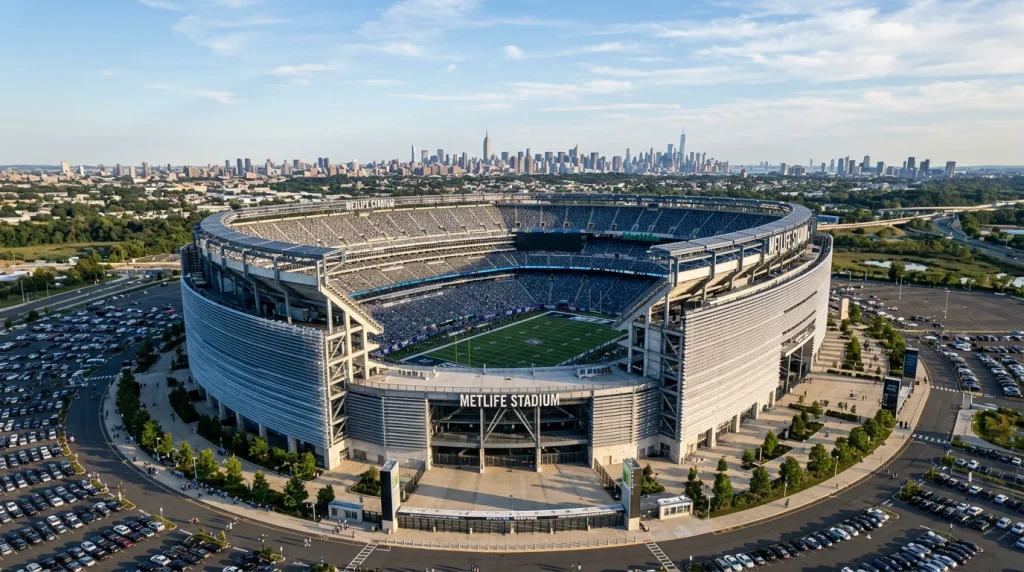
Table of Contents
July 19, 2026. MetLife Stadium. The World Cup Final. Three phrases that represent the ultimate destination for every team that kicks off in June — including our All Whites, regardless of how improbable that journey appears from tournament’s start. MetLife Stadium in East Rutherford, New Jersey, becomes football’s centre of the universe for one July evening when 82,500 spectators witness whichever two nations earned the right to contest the sport’s greatest prize. The trophy will be lifted here, the confetti will fall here, and someone’s dreams will die here. For now, MetLife represents aspiration; by July 19, it becomes history.
The decision to award the World Cup Final to New Jersey rather than Los Angeles, Dallas, or any of the glamorous American alternatives surprised some observers. But FIFA’s logic follows clear reasoning — New York City’s global recognition, the metropolitan area’s 20 million population, and the symbolic significance of concluding the tournament in America’s greatest city. That MetLife sits technically in New Jersey matters little; the New York media market and Manhattan’s 12-mile proximity make this the “New York Final” regardless of state boundaries. The venue where Giants and Jets play NFL football transforms into global football’s grandest stage.
MetLife Stadium: The Big Stage
MetLife Stadium opened in 2010 as a replacement for the original Giants Stadium, costing $1.6 billion to construct without public funding — a rarity in American sports facility development. The open-air design sits lower in the surrounding landscape than traditional stadiums, creating an intimate bowl atmosphere despite the 82,500 capacity. Four video boards at each corner provide replay capability, while the ring of luxury suites circles the upper deck in configurations that NFL economics demand but football atmospheres don’t necessarily benefit from.
The stadium’s lack of roof becomes significant for World Cup Final considerations. July in New Jersey brings summer humidity and temperatures that regularly exceed 30°C. Evening kickoffs reduce heat impact, but players and spectators will experience conditions dramatically different from air-conditioned venues elsewhere in the tournament. Previous major events at MetLife — including Super Bowl XLVIII in 2014 where cold rather than heat presented challenges — demonstrated the venue can handle major occasions despite weather exposure.
Natural grass surfaces replace MetLife’s regular artificial turf for World Cup fixtures, following FIFA mandates that apply across all tournament venues. The installation process, refined through previous major events, produces playing conditions that meet international standards even if the grass-on-concrete arrangement lacks the natural soil base that European pitches enjoy. Quality monitoring throughout the tournament ensures Final match conditions meet the occasion’s demands.
Transportation infrastructure surrounding MetLife evolved specifically for major event management. The stadium sits in the Meadowlands Sports Complex alongside American Dream mall, with rail connections to Manhattan and surrounding areas. The NJ Transit Meadowlands Rail Line operates special service for events, delivering spectators directly to stadium gates. Bus services from Port Authority terminal provide alternative access. The logistics of moving 80,000+ people through New Jersey marshland have been solved through decades of NFL experience.
The World Cup Final: July 19, 2026
The final match kicks off at 4pm local time — a decision that balances global broadcast schedules, Eastern time zone primetime, and summer heat management. For New Zealand viewers, this translates to 8:00 AM NZST on July 20 — Sunday morning viewing that demands neither overnight dedication nor workplace excuse-making. The timing creates reasonable accessibility for virtually every global time zone, maximising the billion-plus audience FIFA’s flagship fixture commands.
The Final will be preceded by closing ceremony spectacle that American entertainment industries will curate for maximum global impact. Previous World Cup Finals have featured musical performances, cultural displays, and production values that honour host nation creativity. MetLife’s proximity to Broadway, the television industry, and celebrity culture ensures the pre-match spectacle will carry distinctly American flavour — for better or worse depending on preference for sporting occasions versus entertainment production.
Ticket allocation for the World Cup Final follows FIFA’s standard distribution: participating nation allocations (approximately 8,000 seats each to finalists), commercial partnerships, hospitality packages, and public ballot through the FIFA portal. Face value tickets range from several hundred to several thousand dollars depending on category. Secondary market pricing for Finals matches historically exceeds face value by multiples; those attending should secure tickets through official channels or budget accordingly for premium resale access.
The match itself will crown the 22nd FIFA World Cup champion — the first determined through the expanded 48-team format, the first hosted across three nations, and the first concluding in New Jersey. Whichever teams reach this stage will have navigated seven matches across five weeks, demonstrating consistency and adaptability that tournaments demand. The Final’s weight transcends the individual fixture; it represents culmination of a month-long journey that begins in Mexico City on June 11.
Other Matches at MetLife
MetLife Stadium hosts eight World Cup fixtures beyond the Final, establishing the venue as a primary tournament hub alongside SoFi Stadium in Los Angeles. Group stage matches bring four pools to New Jersey across the tournament’s opening weeks. The schedule includes group stage matches featuring South American, European, African, and Asian representatives — a diversity that ensures varied supporter populations experience the venue before the knockout rounds narrow the field.
Round of 32 and Round of 16 fixtures at MetLife position the stadium as knockout stage home for Eastern seaboard audiences. The semi-final allocation confirms MetLife’s status among the tournament’s premier venues, with only the Final carrying greater significance. Teams advancing through tournament brackets may play multiple matches here, developing familiarity with the venue that could provide subtle advantages in crucial fixtures.
The tournament’s opening weeks see MetLife’s atmosphere develop through accumulated matches. Early fixtures establish operational patterns; later matches benefit from refined logistics. By the time knockout rounds arrive, venue staff understand crowd management intimately, broadcast positions optimise camera angles, and the playing surface has been tested through competition. The Final represents MetLife at its tournament-honed best rather than opening-match uncertainty.
New York/New Jersey for Kiwi Fans
The New York metropolitan area offers World Cup experiences unlike any other tournament destination. The city that never sleeps accommodates football supporters within entertainment ecosystems that dwarf other host cities’ offerings. Broadway shows, world-class dining, Central Park recreation, and cultural institutions — the Met, MoMA, Natural History Museum — provide non-football activities that justify trip extensions beyond match attendance.
Accommodation options near MetLife Stadium prove limited; the Meadowlands sits in industrial/entertainment development rather than tourist neighbourhoods. Most visitors base themselves in Manhattan, accepting the transit journey to matches in exchange for staying in one of the world’s great cities. Hotels in Times Square, Midtown, and Downtown provide subway access to Penn Station, where NJ Transit trains connect to MetLife. The 30-40 minute journey becomes part of match-day experience, crowds building as the train approaches the stadium.
Newark Liberty Airport provides the closest international gateway, with JFK and LaGuardia offering alternatives depending on airline routing. Air New Zealand operates Auckland-New York services that position Kiwi travellers conveniently for matches on the East Coast. The 17+ hour journey crosses the Pacific and North America; jet lag intensity exceeds West Coast destinations but manageable breaks in LA or Hawaii can ease the transition.
July timing places Kiwi visitors in New York summer — hot, humid, and energetic in ways that winter-arriving tourists might not anticipate. The city operates differently in summer months; outdoor dining flourishes, parks fill with activity, and air conditioning becomes non-negotiable for comfortable sleep. Packing accordingly prevents discomfort that diminishes match-day enjoyment.
MetLife’s Big Moments
MetLife Stadium’s brief history includes hosting Super Bowl XLVIII in 2014 — the first Super Bowl played in cold-weather outdoor conditions, where Seattle demolished Denver in a memorable blowout. The venue has welcomed concerts by global superstars from Taylor Swift to U2, collegiate football championships, and international soccer friendlies that previewed World Cup capability. Each major event refined operational expertise that World Cup hosting demands.
The 2026 World Cup Final represents MetLife’s most significant fixture — an event that will define the stadium’s legacy regardless of subsequent events. Super Bowls rotate annually; World Cup Finals arrive in any given location perhaps once per generation if at all. Whatever happens on July 19, 2026 will echo through MetLife’s identity indefinitely, the venue forever associated with whoever lifts the trophy that evening.
For New Zealand, MetLife represents the ultimate aspirational destination. The All Whites reaching the Final would require victories across six matches that probability suggests won’t happen — but probability also suggested we wouldn’t qualify for this tournament at all. Every journey begins somewhere; ours starts in Los Angeles against Iran. MetLife awaits at the end of a path we’ve earned the right to dream about, however distantly that destination appears from Group G’s realistic assessment.
Where Dreams Converge
MetLife Stadium on July 19, 2026 becomes the geographical and emotional centre of global football. The venue matters less than the occasion it hosts — two teams, one trophy, immortality for the victors and heartbreak for the vanquished. For punters, the Final represents the culmination of tournament-long analysis; for supporters, it represents dreams either fulfilled or extended into future tournament cycles.
Whether your interest in MetLife extends beyond academic curiosity depends on All Whites fortunes that unfold between Los Angeles and Vancouver before any thoughts of New Jersey become relevant. The stadium exists as aspiration now; it becomes reality only for teams that earn the right to contest football’s ultimate fixture. That earning begins in group stages where New Zealand faces challenges enough without contemplating Final implications. MetLife will still be there in July; reaching it requires navigating June first.
