
World Cup 2026 Bet Types: Every Market Explained for Kiwi Punters
 Available in US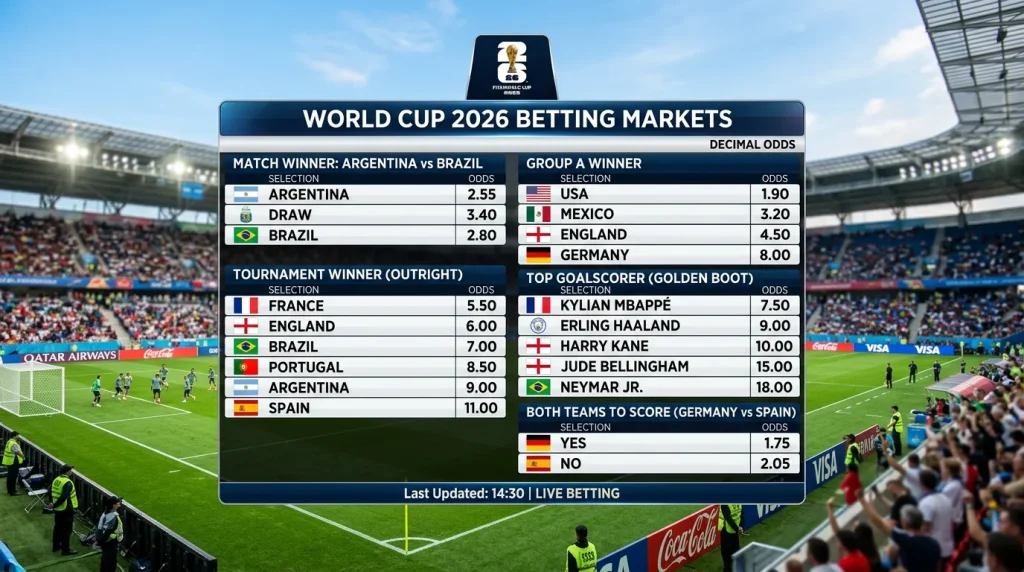
Table of Contents
A mate of mine placed his first World Cup bet during Russia 2018 — backing Germany to beat Mexico at 1.45 — and watched in disbelief as the defending champions lost 1-0. He had no idea that match betting represented just one tiny corner of the World Cup betting universe. Four years later, he had discovered Asian handicaps, both teams to score accumulators, and anytime scorer markets that transformed how he approached tournament wagering. World Cup 2026 bet types extend far beyond simply picking winners and losers, offering Kiwi punters dozens of ways to engage with matches across the expanded 48-team tournament. Understanding these markets — their mechanics, their risks, and their optimal applications — separates recreational bettors from those who consistently find value across football’s grandest stage.
The betting landscape has evolved dramatically since TAB NZ expanded their football offerings ahead of Qatar 2022. Where once New Zealand punters faced limited options focused primarily on match results, today’s markets cover everything from individual player performances to minute-by-minute in-play propositions. This guide breaks down every major World Cup 2026 bet type available to Kiwi bettors, explaining not just what each market involves but when and why you might consider backing it. Whether you are placing your first tournament wager or refining a strategy developed across multiple World Cups, understanding the full spectrum of available markets creates opportunities that casual observers miss entirely.
Match Betting: Win, Draw, or Lose
I once watched a pub full of confident punters back Brazil at 1.20 against Switzerland in 2018, only for the match to finish 1-1. Those short odds meant risking five dollars to win one dollar of profit — and even that modest return never materialised. Match betting seems straightforward until you realise how often tournaments produce unexpected results that compress value out of supposedly safe outcomes. The three-way match result market forms the foundation of World Cup betting, but mastering it requires understanding why obvious selections rarely deliver long-term profit.
Three-way match betting — also called 1X2 — offers three possible outcomes: home win, draw, or away win. At World Cup 2026, the “home” and “away” designations follow fixture scheduling rather than actual geography, since neutral venues host every match. Odds reflect bookmaker assessment of each outcome’s probability, with favourites carrying shorter prices and underdogs offering larger potential returns. A match between Argentina and Saudi Arabia might see Argentina priced at 1.15, the draw at 8.00, and Saudi Arabia at 21.00 — numbers that tell you exactly how bookmakers view relative chances.
The draw deserves particular attention in World Cup betting. Tournament football produces draws more frequently than domestic leagues because teams often play cautiously against unfamiliar opponents, conserving energy for subsequent matches. Group stage matches regularly finish level, particularly when both teams calculate that a point satisfies their qualification arithmetic. Draw prices typically range from 3.00 to 4.50 in competitive World Cup fixtures, offering attractive returns for punters who identify matches likely to produce stalemates.
Double chance betting removes one outcome from consideration, allowing you to cover two of three possibilities with reduced odds. Backing “Argentina or draw” against Saudi Arabia might price around 1.02 — virtually no return — but against stronger opponents the market becomes interesting. New Zealand double chance “draw or win” against Iran could offer 2.50 or higher, providing safety net coverage that pure match betting lacks. The trade-off involves accepting lower returns for increased probability of success.
Draw no bet eliminates the draw entirely, refunding stakes if matches finish level while paying out on wins. This market suits punters who believe one team will win if either team does, without confidence that the favourite avoids draws. Backing Belgium draw no bet against Egypt might return 1.35 rather than 1.50 for the straight win, but your stake survives a 0-0 or 1-1 result. The insurance costs potential profit but reduces variance significantly across multiple selections.
Outright Markets: Tournament Winner and Beyond
Before Qatar 2022 kicked off, I placed a small stake on Argentina at 5.50 — longer odds than their eventual triumph justified, reflecting market uncertainty about Messi’s supporting cast and the team’s 2018 disappointment. That bet delivered my best World Cup return ever, though I also held losing tickets on France and Brazil that the Argentina payout covered comfortably. Outright markets reward patience and early positioning, but they demand acceptance that most selections will fail regardless of how well-reasoned your analysis seems.
Tournament winner betting opens months before kickoff and closes once the opening match begins. Early odds typically offer better value than prices available during the tournament, though injury news and qualifying form can shift markets dramatically. Argentina currently sit around 4.50 to defend their title, with France at 5.50, England at 6.00, and Brazil at 8.00 — the quartet that bookmakers consider most likely to lift the trophy. Backing any of these teams requires accepting that roughly 80% of the time your money disappears; the potential returns must justify that reality.
“To reach the final” markets offer middle-ground propositions between outright victory and group stage advancement. If you believe Argentina will reach the final but face coin-flip chances once there, backing them at 2.25 to reach the decider might represent better value than 4.50 for outright victory. The reduced uncertainty — teams need only survive six matches rather than seven — translates to shorter odds but higher strike rates across multiple tournament cycles.
Group winner betting focuses on the first phase, asking which team tops each of the 12 groups. These markets often reveal fascinating dynamics — Group G sees Belgium priced around 1.25 to finish first, but their ageing squad and the challenge from Egypt and Iran create more uncertainty than those odds suggest. Finding groups where multiple teams possess genuine winning credentials often produces better value than backing overwhelming favourites in weaker sections.
Top group goalscorer markets narrow further, identifying which player scores most within their specific group. These micro-markets reward deep research into fixture sequences and playing styles. A striker facing three defensive opponents might outscore a more talented forward whose group features open, attacking football that distributes goals across multiple players. The limited sample size — three matches maximum — creates variance that works both for and against shrewd selection.
Goals Markets: Over/Under and Both Teams to Score
The 2022 World Cup averaged 2.67 goals per match — lower than bookmaker expectations reflected in pre-tournament totals lines. I backed unders consistently through the group stage and built a decent profit before the knockout rounds produced higher-scoring affairs that erased my advantage. Goals markets reward understanding tournament patterns, but those patterns shift between phases as stakes increase and tactical approaches evolve. Matching your betting to tournament rhythm matters enormously.
Over/under betting sets a goal threshold — typically 2.5 for standard markets — and asks whether the match produces more or fewer goals than that line. Over 2.5 goals wins if three or more goals are scored; under 2.5 wins with two goals or fewer. The half-goal ensures definitive outcomes without push results. Prices fluctuate based on team attacking and defensive records, with overs favouring matches involving attacking teams and unders suiting defensive encounters.
Alternative goal lines provide flexibility around the standard 2.5 threshold. Over 1.5 goals offers shorter prices but higher probability — most World Cup matches produce at least two goals. Over 3.5 or 4.5 goals delivers larger returns but requires genuinely open, attacking encounters that tournaments rarely produce. Asian goal lines like 2.25 or 2.75 split stakes across adjacent thresholds, offering partial wins or losses when results land between whole numbers. A 2-1 scoreline against an over 2.25 line wins half the stake (the over 2 portion) and loses half (the over 2.5 portion).
Both teams to score asks simply whether each team finds the net regardless of final result. This market suits fixtures where you expect competitive football without confidence about who wins. Matches between evenly matched opponents — Portugal versus Netherlands, for instance — often produce both teams scoring even when results could go either way. BTTS prices typically hover around 1.75-2.00 in competitive World Cup fixtures, with variations based on defensive and attacking reputations.
First half goals and second half goals markets segment matches into halves, asking similar over/under or BTTS questions about specific periods. World Cup matches often start cautiously with goals arriving after halftime, making under 0.5 first half goals (no goals before the break) an interesting systematic approach. Conversely, teams chasing results in second halves produce attacking football that favours over 1.5 second half goals in certain scenarios. The segmented approach demands understanding how tournament matches typically unfold.
Scorer Markets: Anytime, First, Last
My most memorable World Cup scorer bet came in 2014 when I backed James Rodríguez at 40.00 for the Golden Boot before Colombia’s campaign began. His six goals delivered extraordinary returns on a modest stake, though I would need those odds again to replicate such profit given how rarely outside chances actually win. Scorer markets range from high-variance Golden Boot propositions to match-specific bets where identifying likely goalscorers creates consistent edge.
Anytime scorer betting asks whether a specific player scores at least once during a match. Prices vary dramatically based on player quality, position, and opponent — Kylian Mbappé might be priced at 1.50 to score against a weaker opponent while a defensive midfielder could sit at 15.00 or longer. The market rewards identifying players likely to receive goal-scoring opportunities and convert them, combining expected minutes, shot frequency, and finishing quality into a single assessment.
First goalscorer markets offer higher returns but lower probability than anytime equivalents. Backing Mbappé first scorer might return 3.50 compared to 1.50 anytime, reflecting the additional requirement that he scores before anyone else rather than at any point. Penalty takers gain slight advantages in first scorer markets since spot kicks often arrive early in competitive matches. The market also creates opportunities around set-piece specialists who might score from corners or free kicks in opening exchanges.
Last goalscorer markets work identically to first scorer but focus on who nets the final goal. Substitute strikers gain relevance here since fresh legs attacking tired defences in closing minutes sometimes produce decisive goals. The market carries similar variance to first scorer but follows different logic — rather than identifying who starts aggressively, you are identifying who finishes matches strongly.
Golden Boot betting spans the entire tournament, identifying the top scorer across all 64 matches. Historical winners typically need six or more goals, requiring their team to advance deep into knockout rounds while they personally maintain form throughout. Backing players from nations likely to reach semi-finals or the final narrows the field; Golden Boot odds for players whose teams might exit in the group stage represent lottery tickets regardless of individual quality. The market opens months before the tournament and odds shift significantly based on team progression.
Special Bets: Cards, Corners, and More
Corners nearly bankrupted a betting syndicate during the 2010 World Cup when their “unders” approach ran headlong into a tournament featuring surprisingly attacking football. I learned from their publicised failure to never underestimate how much special markets can diverge from historical patterns. Cards, corners, and other peripheral propositions offer interesting diversification away from goals and results, but they carry their own complexities that casual bettors frequently underestimate.
Card betting markets cover bookings and sendings off, offering over/under lines on total cards shown or team-specific card counts. World Cup referees historically show more cards than domestic league officials, partly because unfamiliar opponents commit tactical fouls more frequently and partly because tournament stakes encourage calculated fouling to break opposition momentum. Over 3.5 cards prices attractively in matches between physical teams with contrasting styles — South American versus European encounters often produce yellow card accumulation.
Corner markets operate similarly to goals markets, with over/under lines typically set around 9.5 or 10.5 for World Cup matches. Attacking teams generate more corners through sustained pressure that produces deflections and goalkeeper saves redirecting shots. Dominant favourites facing defensive opponents often accumulate double-digit corners while conceding few — backing team-specific corner overs in mismatched fixtures sometimes offers better value than match corners totals.
Winning margin betting asks not just who wins but by how much. Markets typically offer “one goal,” “two goals,” or “three or more goals” brackets for each team, plus draw and various scoreline outcomes. Backing Belgium to win by exactly two goals against weaker opposition might deliver 4.00 returns — attractive if you believe Belgian quality ensures victory without expecting demolition. The market rewards nuanced prediction beyond binary win/lose thinking.
Half-time/full-time betting combines two predictions, asking both who leads at the break and who wins overall. Matches where favourites struggle early before imposing themselves — common in World Cup football — offer value in selections like “draw/Argentina win” that capture slow-starting victories. The nine possible outcomes (three half-time results multiplied by three full-time results) create pricing complexity where sharp bettors occasionally find bookmaker errors.
Live Betting Markets During Matches
Watching the 2022 final, I placed a live bet on Argentina after Mbappé equalised at 2-2 in extra time — the market briefly offered 3.00 on Argentina victory when momentum seemed to favour France. That bet pushed to penalty shootout territory before Argentina prevailed, delivering profit that pre-match backing at 2.00 would not have matched. Live betting transforms World Cup watching into dynamic engagement where reading match flow creates opportunities that pre-match markets cannot provide.
In-play odds adjust continuously based on scoreline, time remaining, and momentum shifts. Goals immediately compress winning odds for the scoring team while lengthening prices for opponents. Red cards produce similar dramatic shifts, with ten-man teams suddenly facing vastly extended odds to win matches. These adjustments often overreact to single events, creating value for punters who believe teams can overcome adversity or that leads remain vulnerable.
Next goal markets offer simple propositions during matches — which team scores next, or will there be another goal at all? These markets suit punters who read attacking momentum without wanting to predict final outcomes. Backing “next goal home team” when pressure mounts captures immediate situations without requiring the match to follow expected trajectories through ninety minutes.
Cash out options allow bettors to settle positions before markets close, locking in profit on winning positions or recovering partial stakes on losing ones. If your pre-match Argentina bet sits in profit at halftime, cash out offers guaranteed returns against the risk of second-half collapse. The feature suits risk-averse bettors willing to accept reduced returns for certainty, though bookmakers build margin into cash out offers that favour their position over time.
Live betting through TAB NZ during World Cup 2026 will cover New Zealand’s matches with particular depth, allowing Kiwi punters to engage with All Whites fixtures dynamically. If Iran take an early lead against New Zealand, live odds on the draw might lengthen to 4.00 or higher — attractive for those who believe the All Whites can salvage something from the match. Reading match situations and acting on them requires discipline and quick decision-making, but the rewards can exceed pre-match approaches significantly.
Matching Markets to Moments
Eight years of covering World Cup betting taught me that different markets suit different tournament phases. Group stage football rewards draw specialists and unders backing. Knockout rounds produce results and goals more frequently as teams must win to advance. The final often features cagey opening halves followed by explosive closings. Adapting your bet type selection to tournament rhythm creates edge that static approaches cannot match.
For Kiwi punters approaching World Cup 2026, the expanded 48-team format creates additional complexity. More matches mean more betting opportunities but also more potential for variance to accumulate. Focusing on markets you understand deeply rather than spreading stakes across unfamiliar bet types typically produces better long-term outcomes. Master three or four bet types completely before experimenting with peripheral markets that sound interesting but carry hidden complexity.
The All Whites’ three Group G fixtures offer particularly interesting betting variety. Against Iran, draw or New Zealand double chance might provide value. Against Egypt, specific scorer markets featuring Chris Wood deserve attention. Against Belgium, taking points via Asian handicaps could work better than backing outright results. Each match demands different market selection based on realistic assessment of New Zealand’s chances — and that adaptability separates sophisticated punters from those who simply back their team regardless of odds quality.
