
World Cup 2026 Favourites: Who’s Tipped to Win?
 Available in US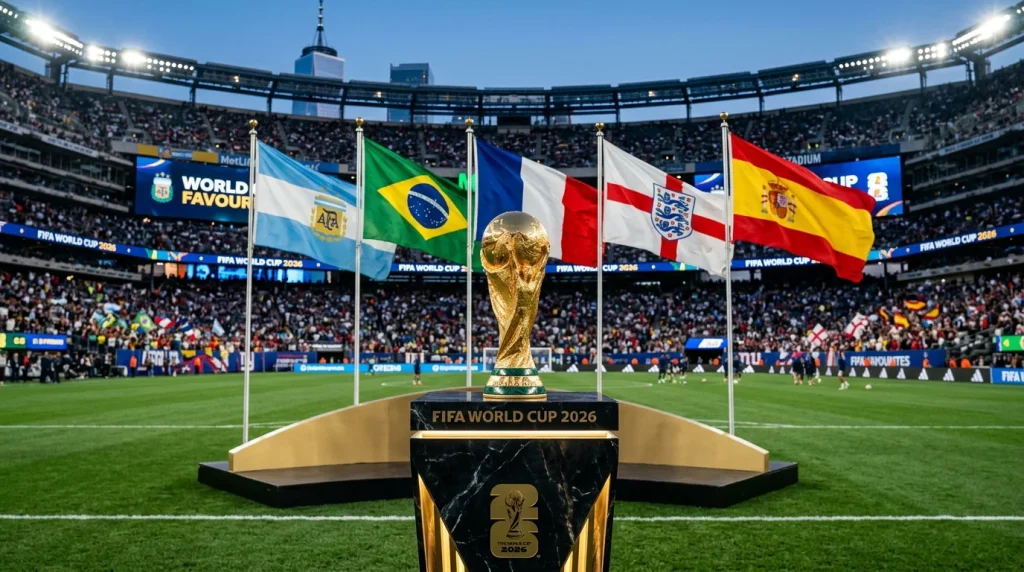
Table of Contents
The last time bookmakers got a World Cup winner dramatically wrong was 2022, when Argentina drifted to 6.50 after losing their opener to Saudi Arabia before rallying to lift the trophy. Before that, Spain won in 2010 despite starting behind Brazil and England in betting markets. The lesson from decades of World Cup betting is clear: favourites win often enough to justify their prices, but not so often that backing them blindly produces profit. World Cup 2026 favourites include the usual suspects — Argentina, France, England, Brazil — alongside European champions Spain and perennial dark horse Germany. Understanding why each nation commands their market position, and where bookmaker assessments might undervalue or overvalue specific contenders, separates informed World Cup betting from blind allegiance to household names.
The expanded 48-team format introduces variables that previous tournaments lacked. More matches create more opportunities for fatigue, injury, and unexpected results to derail favourites before knockout rounds even begin. Simultaneously, the format protects top seeds somewhat — 32 of 48 teams advance past group stages, meaning established powers face significantly reduced elimination risk during the first phase. How bookmakers have priced this structural change into outright odds reflects their assessment of whether expansion helps or hinders elite nations. For Kiwi punters evaluating World Cup 2026 favourites, these dynamics matter as much as squad quality or recent form.
Argentina: Defending Champions
Lionel Scaloni almost quit after the 2022 triumph, exhausted from the pressure of guiding Messi’s generation to glory. Instead, he stayed, won the Copa América again, and built a squad that somehow improved despite key players ageing past their peaks. Argentina at World Cup 2026 represent the most complete team in international football — defending champions with winning culture embedded so deeply that even rotation players understand exactly what success requires. Their 4.50 odds make them clear favourites, but the price compresses value significantly for those who might have backed them earlier.
The Messi question dominates Argentina’s narrative without dominating their functionality. At 38, he will turn 39 during the tournament, raising genuine uncertainty about his physical capacity for seven matches across four weeks. But Scaloni has systematically reduced dependence on Messi’s individual brilliance, building a team where Julián Álvarez, Enzo Fernández, and Alexis Mac Allister create and score without requiring Messi’s involvement. His presence elevates Argentina emotionally and provides decisive moments when matches tighten; his potential absence no longer threatens collapse.
Argentina’s CONMEBOL qualification demonstrated sustained excellence despite occasional rotation. They topped the South American table comfortably, losing only three matches across eighteen rounds while integrating younger players seamlessly. The psychological advantage of defending their title cannot be overstated — every opponent knows Argentina have proven their tournament credentials while most pretenders have not. That confidence differential manifests in decisive moments when pressure peaks.
The concern for Argentina backers involves their ageing core. Nicolás Otamendi, Ángel Di María’s potential farewell, and questions about whether Messi’s body holds up across seven matches all create vulnerability. Draw difficulty could also matter — Argentina might face European powers as early as the round of 16 if seeding does not protect them adequately. At 4.50, you need Argentina to win roughly 22% of the time to break even; their actual probability might not exceed that margin by enough to create genuine value.
France: The 2022 Runners-Up
Kylian Mbappé carried France through the 2022 final almost single-handedly, scoring a hat-trick that should have won any normal match. His transformation from supporting actor behind Griezmann and Benzema to undisputed main character occurred across ninety minutes in Qatar, announcing that France’s future remained golden even as their 2018 generation aged. France at World Cup 2026 pricing around 5.50 acknowledges both their extraordinary talent and the uncertainty surrounding their supporting cast.
Mbappé’s output staggers comprehension. His club and international goal records place him among history’s elite attackers before his 27th birthday, with tournament performances demonstrating that individual brilliance can overwhelm opponents regardless of tactical planning. Four goals in the 2022 final — if you count extra time — showed what happens when Mbappé decides matches alone. France’s system channels resources toward creating his opportunities, and that approach works devastatingly often.
Beyond Mbappé, France’s midfield depth exceeds any other nation. Aurélien Tchouaméni, Eduardo Camavinga, and the emerging talents behind them provide Didier Deschamps options that other managers envy. The Real Madrid contingent brings Champions League experience to international duty, understanding pressure situations from club football’s highest stage. French midfield control typically dictates matches against technically inferior opponents, creating the platform for Mbappé’s decisive contributions.
French defensive questions persist despite individual quality. They conceded seven goals across two matches in the 2022 knockout rounds — Argentina’s final goals and England’s earlier strikes exposed vulnerabilities that superior opponents can exploit. Deschamps’ pragmatic approach sometimes fails against teams willing to attack France rather than sit deep and absorb pressure. The 5.50 odds assume French quality overcomes these concerns; punters must decide whether that assumption holds against knockout opponents like Argentina, England, or Spain.
England: Eternal Nearly-Men
Sixty years without a major trophy should produce discount odds, not betting favourites. Yet England at World Cup 2026 sit around 6.00 — their shortest tournament price since perhaps 1966 itself — reflecting a squad that objectively matches any in world football. The gap between English talent and English tournament achievement creates cognitive dissonance that bookmakers have apparently resolved in favour of quality over history. Whether punters should follow that logic remains genuinely uncertain.
Jude Bellingham has become the player England always needed but never possessed. His combination of midfield control, goalscoring threat, and big-match temperament provides exactly what previous English generations lacked — a player capable of deciding matches individually when collective function stalls. Bellingham’s first season at Real Madrid produced numbers that elite attacking midfielders rarely achieve, and his international performances have matched club excellence consistently.
The supporting cast around Bellingham includes genuinely world-class performers. Bukayo Saka, Phil Foden, and Declan Rice represent Premier League football’s finest products, developed through the most competitive domestic league and tested against elite opposition weekly. Harry Kane’s departure from the national setup following Bayern Munich commitments has actually streamlined the English attack, removing debates about accommodating his specific requirements while freeing more dynamic options.
English tournament psychology remains the reasonable concern. Penalty shootout heartbreaks, tactical conservatism in decisive moments, and the intangible burden of expectation have sabotaged more talented England squads than those who actually won in 1966. Manager Eddie Howe brings a fresh approach after Southgate’s departure, but whether new coaching staff can overcome decades of accumulated failure represents gambling on transformation rather than backing a proven commodity. The 6.00 odds assume England finally convert talent into a trophy; history suggests caution.
Brazil: The Five-Time Champs
No nation carries historical weight like Brazil. Five World Cup victories establish credentials that current results cannot diminish, yet Brazil have not lifted the trophy since 2002 — a drought approaching quarter-century duration that gnaws at Brazilian football’s soul. The Seleção at World Cup 2026 pricing around 8.00 reflects both their perpetual talent and the lingering questions about whether modern Brazilian football matches golden-era brilliance. For punters, Brazil occupy fascinating value territory: long enough to produce significant returns, realistic enough to justify stakes.
Vinícius Jr has emerged as Brazil’s undisputed talisman following Neymar’s injury-enforced decline. The Real Madrid winger won the 2024 Ballon d’Or, confirming his status among world football’s elite performers. His dribbling ability, acceleration, and finishing create problems that defenders simply cannot solve through tactical adjustment — individual brilliance that Brazil have historically relied upon to overcome organised opponents. Vinícius provides what Neymar promised but intermittently delivered.
Brazilian depth concerns persist despite Vinícius’ excellence. The supporting cast — Rodrygo, Raphinha, emerging striker Endrick — possesses quality without quite matching previous generations’ abundance. Midfield balance remains uncertain, with coach Dorival Júnior still searching for combinations that provide defensive security while enabling attacking expression. These tactical questions produced CONMEBOL qualification struggles that saw Brazil finish fifth, barely securing automatic qualification rather than dominating as historical precedent suggested.
At 8.00, Brazil offer genuine value if you believe their talent overcomes organisational questions. Their ceiling matches anyone’s — a fully functioning Brazil side with Vinícius producing at his best could defeat any opponent in any match. The floor involves quarter-final exit against European tactical superiority, continuing the pattern that has defined Brazilian World Cup football since 2002. Punters must decide which Brazil turns up; the odds reward those who guess correctly.
Spain: European Champions
Spain’s Euro 2024 triumph reminded everyone that La Furia Roja remain among football’s elite despite the transition from their 2008-2012 golden generation. The current Spanish squad combines veteran leadership with emerging talents who might define the next decade — a mix that tournament football rewards. Spain’s World Cup 2026 odds around 7.00 position them as genuine contenders rather than afterthoughts, reflecting both their European title and the quality depth that other nations envy.
The Spanish midfield factory continues producing world-class operators. Pedri, Gavi, and the emerging talents behind them perpetuate the possession-based approach that brought unprecedented success earlier this century. Spanish tactical identity — controlling matches through midfield dominance, patient build-up, and positional superiority — translates to tournament football more reliably than counter-attacking approaches that require specific conditions to function. They dictate terms rather than reacting to opponents.
Spanish attacking quality has evolved beyond the Tiki-Taka era’s sometimes sterile possession. Lamine Yamal’s emergence as a genuine difference-maker provides direct threat that previous Spanish generations occasionally lacked. His combination with established forwards creates variety that unpicks defensive blocks through individual skill rather than relying exclusively on collective movement. The tactical evolution makes Spain more dangerous in knockout football where single goals decide advancement.
European competition success does not guarantee World Cup performance — Spain themselves failed to advance past group stages in 2014 as defending champions. The North American venue creates travel and climate challenges that European qualifiers must navigate while South American nations enjoy relative proximity advantages. At 7.00, Spain represent solid value for those who believe European tactical sophistication and proven tournament credentials translate to World Cup success against the best from other continents.
Dark Horses Worth a Look
Every World Cup produces at least one nation that exceeds pre-tournament expectations dramatically. Morocco reached the 2022 semi-finals at 150.00 odds, delivering extraordinary returns for punters bold enough to back African representation seriously. Identifying 2026’s dark horses requires examining which nations combine genuine quality with market undervaluation — a rare intersection that creates betting value beyond the obvious favourites.
Portugal’s pricing around 12.00 reflects uncertainty about their post-Ronaldo identity more than their actual squad quality. Bruno Fernandes, Bernardo Silva, and emerging talents provide creativity that tournament football rewards. Portuguese tactical flexibility under Roberto Martínez allows adaptation to opponents — they can control possession against weaker teams or counter-attack against superior opposition. Their quarter-final ceiling might understate genuine semi-final potential.
Netherlands carry similar dark horse credentials at similar prices. Dutch football’s regeneration under Ronald Koeman has produced a squad combining experienced performers with emerging talents, though their 2022 quarter-final exit to Argentina raised questions about knockout round credentials. The 12.00-15.00 odds range offers attractive returns if Dutch quality materialises across seven matches — realistic enough to justify medium-sized stakes.
Germany’s pricing around 10.00 represents potential value if their home form extends to North American venues. Die Mannschaft have underperformed at recent tournaments, exiting in group stages at consecutive World Cups, but their talent pool remains deep enough for redemption narratives. Florian Wirtz and Jamal Musiala provide creative thrust that previous German generations lacked; their emergence might signal genuine tournament contention rather than continued decline.
For Kiwi punters seeking longer-odds propositions, Croatia (15.00-20.00) deserve consideration despite ageing. Their tournament pedigree — finalists in 2018, third in 2022 — demonstrates that this generation produces when stakes peak. Belgium’s pricing has lengthened enough to create potential value if their golden generation produces one final push. These nations represent calculated gambles rather than favourites, but their odds compensate for reduced probability appropriately.
Current Odds Comparison
Odds shift constantly between now and tournament kickoff, but current market positioning reveals how bookmakers assess relative chances. Argentina lead at 4.50, implying roughly 22% probability of winning — essentially one-in-four-and-a-half chance. France follow at 5.50 (18% implied), then England at 6.00 (17%), Spain at 7.00 (14%), Brazil at 8.00 (12.5%), and Germany at 10.00 (10%). These top six account for approximately 93% implied probability before accounting for bookmaker margin — the remaining 47 teams share roughly 7% combined.
That distribution tells you exactly how bookmakers view the tournament: roughly two-thirds chance that Argentina, France, or England win; one-third chance for everyone else combined. Whether this assessment accurately reflects reality or systematically overvalues familiar names represents the fundamental question for value-seeking punters. Historical evidence suggests European and South American powers dominate World Cups with only occasional exceptions — the favourites are favoured for defensible reasons.
Monitoring odds movements between now and June 2026 creates opportunities for those paying attention. Injury news, qualifying results, and market money flows will shift prices — Argentina might drift to 5.50 if Messi’s fitness becomes questionable, or compress to 3.50 if early tournament results confirm their dominance. Locking in current prices through early bets captures present assessments; waiting risks worse odds if your selection’s form improves but allows better prices if concerns emerge.
Where Value Hides
True betting value at World Cup 2026 probably does not lie with the outright favourite. Argentina’s 4.50 offers fair rather than generous returns for the bookmaker’s perceived most likely outcome. Value hunting requires identifying discrepancies between market prices and actual probabilities — nations whose odds exceed what their genuine chances justify.
The 8.00-12.00 range might contain the tournament’s best propositions. Brazil, Germany, and Portugal all possess talent capable of winning seven consecutive matches, yet their odds provide better returns than top-tier favourites. If you believe any of these nations has 15% genuine probability of winning — reasonable for teams with their quality — current odds offering 8.00-12.00 represent positive expected value. The challenge involves assessing true probability accurately, which nobody does consistently.
For Kiwi punters approaching World Cup 2026 odds, diversification across multiple genuine contenders typically outperforms concentration on single favourites. Placing equal stakes on Argentina, France, England, Brazil, and one dark horse creates portfolio-style exposure where any single winner produces profit while multiple selections limit catastrophic loss if your preferred choice disappoints. The approach sacrifices maximum upside for improved consistency — a trade-off that suits most recreational bettors’ risk tolerance.
