
Argentina at World Cup 2026: Defending Champions
 Available in US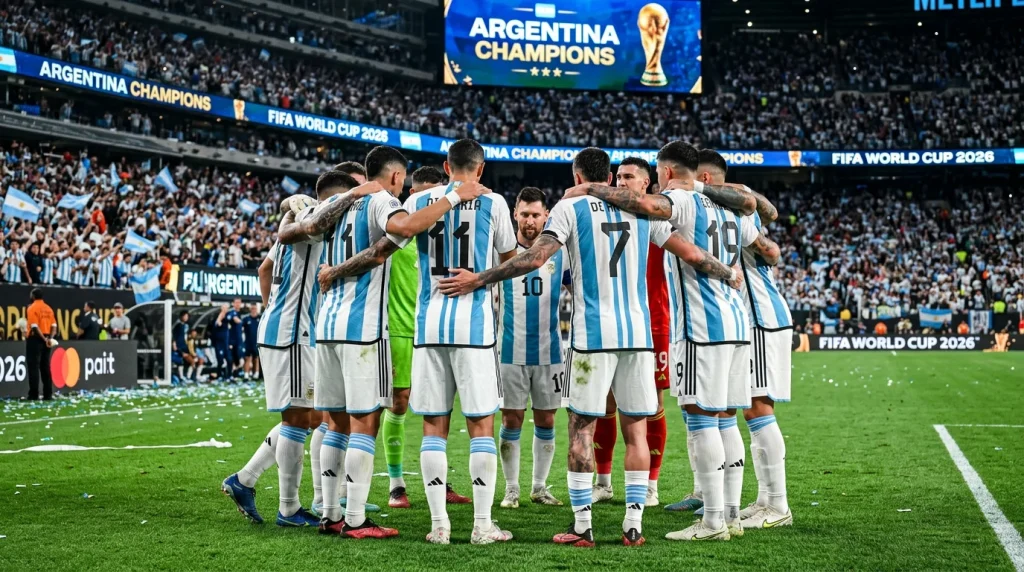
Table of Contents
Lionel Scaloni faced the press three days after lifting the World Cup trophy in Qatar, and a journalist asked what came next. “We enjoy this for the rest of our lives,” he replied, before pausing and adding, “but the work continues.” That answer captured everything about Argentina’s approach to defending their title at World Cup 2026 — celebration of historic achievement mixed with recognition that football never stops demanding more. The Albiceleste arrive in North America as defending champions, Copa América holders, and consensus favourites to lift the trophy again. For Kiwi punters analysing tournament markets, Argentina present the most straightforward proposition: they should win, they probably will win, and the odds reflect this reality with minimal value available for straightforward outcomes.
Argentina’s dominance across the past four years defies typical international football patterns. Nations usually experience cycles of success followed by rebuilding periods as generations age out and replacements require development time. Argentina have somehow extended their peak despite key players approaching career twilight, adding young talents seamlessly while maintaining the tactical identity and winning culture Scaloni established. Whether this sustains through another World Cup campaign remains the central question surrounding their 2026 ambitions.
CONMEBOL Campaign: The Champs Cruise
Argentina qualified for World Cup 2026 with characteristic comfort, topping the CONMEBOL standings by five points despite the region’s demanding 18-match qualification format. They accumulated 39 points from 18 matches — 12 wins, 3 draws, and 3 defeats — establishing dominance that reinforced their global standing. The defending champions treated qualification as preparation rather than challenge, using matches to develop tactical variations and integrate younger players without compromising results.
Scaloni rotated his squad extensively during qualification, managing workloads for ageing stars while providing emerging talents meaningful international minutes. This approach occasionally produced defeats — losses to Uruguay, Colombia, and Paraguay demonstrated vulnerability when second-string lineups faced motivated opponents — but never threatened qualification itself. Argentina’s depth allows them luxuries that other nations cannot contemplate.
Defensively, Argentina conceded 12 goals across qualification — 0.67 per match — respectable rather than dominant. The backline that performed impeccably at Qatar 2022 has aged; Nicolás Otamendi and Cristian Romero still provide quality but lack the recovery pace that elite attackers exploit. Scaloni addressed this by lowering defensive lines slightly, trading pressing intensity for positional security. Whether this adjustment suffices against European pace at the World Cup remains uncertain.
Attacking production exceeded expectations despite Messi’s reduced involvement. Argentina scored 33 goals during qualification, with Julián Álvarez leading the charts and contributions distributed across multiple forwards. This offensive diversity represents crucial evolution — Argentina can threaten without depending entirely on Messi magic, creating problems for opponents who designed defensive plans around neutralising one player.
The Messi Question: Will He Play?
Lionel Messi turns 39 during World Cup 2026. Let that reality settle. The greatest footballer most of us will ever witness approaches the tournament that would cap his career — assuming he participates at all. Messi’s fitness, form, and willingness to endure another gruelling tournament campaign dominate discussions about Argentina’s chances. Everything else feels secondary to whether the number 10 takes the pitch.
Messi’s performances at Inter Miami during the 2025-26 MLS season provided mixed signals. He scored 18 goals and created 14 assists across all competitions — production that validates continued quality — but missed seven matches through minor injuries that would not have sidelined him five years earlier. His body tells him what his mind refuses to accept: the physical demands of elite football increasingly exceed what his legs can provide.
Scaloni has prepared contingencies regardless. Argentina’s tactical structure no longer channels everything through Messi; instead, he operates as elevated finisher and creative spark within a system that functions without him. Julián Álvarez can lead attacks independently. Enzo Fernández dictates tempo from midfield. Alejandro Garnacho provides direct threat from wide positions. Messi enhances rather than enables — a crucial distinction that protects Argentina from his absence.
The romantic scenario involves Messi producing another transcendent tournament performance, lifting a second World Cup trophy to cement the greatest individual career in football history. The pragmatic scenario involves Messi contributing selectively, starting matches where his experience matters most while Scaloni manages his minutes carefully. The concerning scenario involves Messi’s body failing at the worst possible moment, leaving Argentina emotionally devastated at the tournament where farewells seemed destined.
For punters, Messi’s participation influences numerous markets beyond simply Argentina outright odds. His absence would lengthen their prices noticeably while opening value opportunities for those believing Argentina’s depth compensates. His presence keeps odds compressed but adds confidence that decisive moments will feature his involvement. Monitoring Messi’s fitness through friendlies and early tournament matches shapes how Argentina bets should be approached.
Beyond Messi: Argentina’s Depth
Julián Álvarez has established himself as Argentina’s primary striker regardless of Messi’s participation. The Atlético Madrid forward combines pressing intensity with clinical finishing, offering defensive contribution that Messi never provided while maintaining goalscoring threat at elite levels. Álvarez scored eight goals during qualifying and has netted in multiple Champions League knockout matches — production demonstrating his readiness for World Cup pressure.
Enzo Fernández transformed from emerging prospect to world-class midfielder across the past three years. His passing range, defensive positioning, and ability to control tempo make him indispensable to Scaloni’s system. Fernández’s performances at Chelsea have occasionally underwhelmed relative to his price tag, but international football unlocks his best qualities — he understands Argentinian tactical demands intuitively and executes them consistently.
Alejandro Garnacho represents Argentina’s exciting future arriving at precisely the right moment. The Manchester United winger possesses dribbling ability and directness that creates chaos for defenders, providing attacking dimension that Argentina lacked before his emergence. Garnacho’s temperament for tournament football remains untested at senior international level, but his club performances suggest readiness for the World Cup stage.
Defensively, Lisandro Martínez provides aggressive organisation from centre-back. His willingness to step forward and intercept, combined with aerial dominance despite modest height, makes him the defensive leader Scaloni trusts implicitly. Around Martínez, options like Cristian Romero and Nicolás Tagliafico bring experience while younger alternatives develop. The backline is not Argentina’s strength, but it functions effectively within Scaloni’s system.
Goalkeeper Emiliano Martínez remains among the world’s elite shot-stoppers and penalty specialists. His psychological gamesmanship during shootouts has become legendary following Qatar heroics, and his command of the penalty area provides security that allows defenders confidence. Martínez’s distribution improved significantly since joining Aston Villa, adding another dimension to Argentina’s build-up play.
Group J: Algeria, Austria, DR Congo
Argentina received a favourable draw in Group J, avoiding the concentrated European quality that could have complicated advancement. Algeria represent their toughest test — African champions with organised defensive structure and counterattacking threat. Austria bring European professionalism without the individual brilliance to trouble Argentina’s best. DR Congo complete the group as significant underdogs unlikely to threaten established powers.
Algeria warrant respect following their Africa Cup of Nations triumph and consistent performances across recent years. Their defensive discipline frustrated European opponents during qualification, and they possess attackers capable of punishing mistakes. Argentina versus Algeria on June 13 in Philadelphia could produce closer margins than casual observers expect if the Algerians execute their gameplan effectively.
Austria qualified through UEFA’s demanding pathway, defeating quality opponents to earn their berth. David Alaba’s injury absence removes their most influential player, but Austrian organisation and set-piece threat create potential problems regardless. This fixture represents Argentina’s clearest path to three points while still requiring professional performance to secure victory.
DR Congo qualified through CAF as one of Africa’s emerging forces, but their squad depth cannot match established nations across 90 minutes. Argentina should win comfortably while managing minutes ahead of knockout rounds. The goal difference accumulated against Congo could prove valuable if Group J tiebreakers apply.
Bookmakers price Argentina below 1.10 to win Group J, essentially treating their advancement as certainty. To win the group pays around 1.25 — minimal return for the effort of placing bets. More interesting angles involve match-specific markets against Algeria or Argentina’s total points across three fixtures.
Argentina World Cup 2026 Betting Odds: Price of Champions
Argentina sit around 4.50 to win World Cup 2026 outright — the shortest odds in the tournament reflecting their status as defending champions with elite squad quality. The implied probability of approximately 22% feels about right for a nation that could credibly defeat any opponent but faces competition from multiple European heavyweights with their own championship credentials.
Finding value in Argentina markets requires creativity given compressed odds. Backing Argentina to reach the final offers better returns than outright markets while acknowledging their likely knockout progression. Specific match bets against Algeria could provide value if you believe African organisation causes Argentina problems. Player props involving Álvarez or Fernández sometimes underprice their expected contributions.
Messi’s individual markets present fascinating opportunities. His Golden Boot odds around 10.00 assume both health and Argentina progression deep into the tournament — achievable but far from guaranteed. Messi to score in the final combines his historical moment with tournament success, pricing attractively for those believing in destiny narratives. His appearance markets — whether he plays, how many minutes he accumulates — offer proposition bets disconnected from match outcomes.
Argentina’s defensive vulnerabilities create over/under opportunities against attacking opponents. Both teams to score against European opposition in knockout rounds prices attractively given Argentina’s susceptibility to pace and their opponents’ need to chase matches. Argentina clean sheet prices against Algeria or Austria offer value in the opposite direction for those trusting Scaloni’s organisation.
Asian handicap markets reflect Argentina’s favouritism throughout the tournament. They give up starts in every match except perhaps a hypothetical final against France or Brazil. The spreads matter because Argentina sometimes win narrowly against organised opposition rather than overwhelming them — 1-0 and 2-1 victories appear regularly in their recent results.
World Cup History: Third Title in Qatar
Argentina’s 2022 World Cup triumph provided one of football’s most emotional conclusions. Messi finally won the trophy that eluded him across four previous tournaments, defeating France in a final widely considered the greatest World Cup match ever played. The 3-3 draw that required penalties featured Messi magic, Mbappé’s hat-trick response, and drama that will be replayed for generations. That night in Lusail completed Messi’s legacy while establishing Argentina’s contemporary credentials.
Argentina’s previous World Cup victories came in 1978 and 1986 — the latter featuring Maradona’s transcendent individual tournament that established his deity status in Argentine culture. The comparison between Messi and Maradona dominated football discourse for 15 years before Qatar settled debates for most observers. Messi now chases a third star for Argentina’s jersey, which would match Germany and Italy while trailing only Brazil’s five.
Between 1986 and 2022, Argentina reached two finals without winning — losing to Germany in 1990 and 2014. Those defeats, particularly the latter where Messi lost to Mario Götze’s extra-time goal, shaped narratives about choking and curse until Qatar’s redemption. Argentina’s tournament psychology has transformed from burdened to liberated; they approach 2026 as hunters rather than hunted despite defending champion status.
Historical patterns suggest defending champions face unique challenges. Only Brazil (1962) and Italy (1938) have won consecutive World Cups since the tournament’s inception, with multiple defending champions exiting in group stages or early knockout rounds. Argentina must overcome history as well as opponents to retain their title.
Can Argentina Repeat?
Argentina should reach the semi-finals at minimum and probably the final. Their squad quality, tournament experience, and winning culture provide advantages that most opponents cannot match. Whether they lift the trophy again depends on matchups, form, and the margins that separate glory from disappointment in single-elimination football.
The European challenge looms largest. France, England, Germany, and Spain all possess the quality to defeat Argentina across 90 or 120 minutes. European football’s tactical sophistication and physical intensity creates problems that South American creativity does not always overcome. Argentina’s knockout record against European opposition since 2006 reads positively — they defeated France in 2022 — but each tournament brings fresh challenges.
Scaloni’s management proves crucial. His willingness to adjust tactically between matches, rotate players to maintain freshness, and make difficult decisions about ageing stars has distinguished Argentina from talented squads that underperformed. If Scaloni navigates the World Cup’s demands as effectively as he handled Qatar, Argentina’s chances improve significantly. Managerial influence matters enormously in tournament football.
For Kiwi punters, Argentina represent the tournament’s safest advanced-round bet without offering value in outright markets. Back them to reach semi-finals with confidence; approach the trophy bet with awareness that 4.50 odds imply 22% probability — meaning they fail to win roughly four times out of five even as favourites. Argentina are excellent, but excellence does not guarantee victory against competition featuring multiple excellent alternatives.
