
England at World Cup 2026: Will Football Finally Come Home?
 Available in US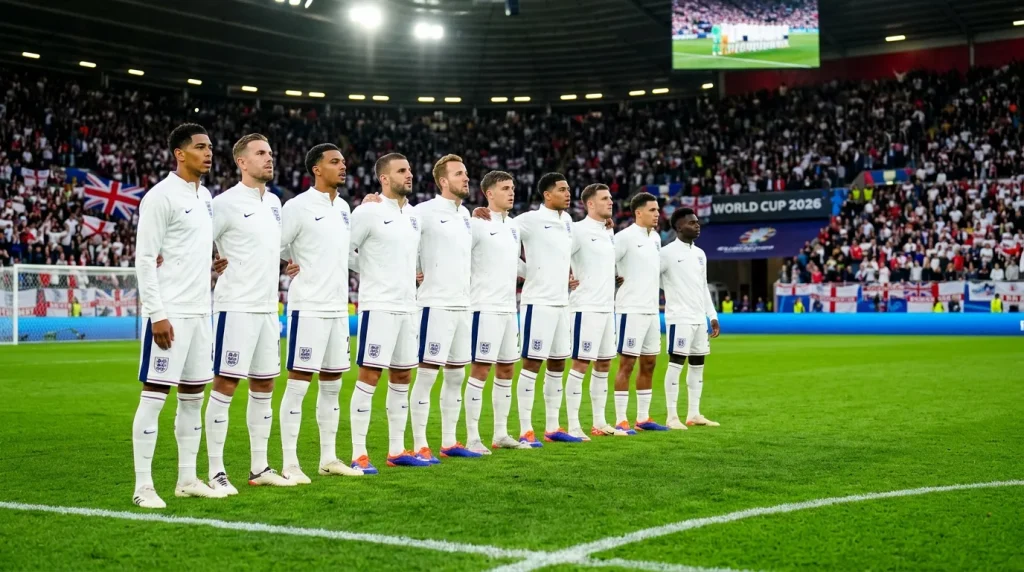
Table of Contents
Sixty years of hurt stretches to sixty-two by the time World Cup 2026 kicks off in North America. I have covered English football through enough near-misses and tournament heartbreaks to approach their prospects with earned cynicism, yet I cannot ignore the quality staring back from their squad list. England at World Cup 2026 arrive with arguably their most talented group of players since 1966 — perhaps ever — featuring a midfield conductor in Jude Bellingham who plays like Zinedine Zidane reborn, wingers capable of destroying any defence, and depth that allows genuine rotation without significant quality drop. The question haunting English football is not whether they possess championship-calibre players, but whether this nation can translate supreme talent into major tournament victory. History suggests pessimism; current form whispers that this time might actually differ.
The post-Southgate era has reinvigorated English football’s self-belief. Whatever criticisms accompanied his tenure — the conservative tactics, the questionable substitution timing, the tournament defeats in finals and semi-finals — Gareth Southgate rebuilt England into a nation that expects advancement rather than hopes for it. His successor inherited both the squad and the culture, adding tactical flexibility while maintaining the cohesion Southgate cultivated. England approach 2026 as genuine contenders rather than hopeful outsiders, which represents transformation as significant as any tactical innovation.
UEFA Qualification: England’s Path
England qualified with characteristic efficiency, winning their group by seven points while scoring 26 goals and conceding just four across eight matches. The defensive record stood out — 0.5 goals conceded per game demonstrated organisation that sometimes gets overlooked when discussing English attacking talent. Clean sheets against Ukraine, North Macedonia, and both meetings with Malta reinforced that this squad can win ugly when attractive football fails to produce early breakthroughs.
New manager Eddie Howe stamped his authority on English tactical approach during qualification’s second half. Where Southgate preferred controlled possession and patient build-up, Howe encourages directness and pressing intensity reminiscent of his Newcastle work. The adjustment period produced one concerning defeat — Italy away in Rome — but subsequent performances vindicated the stylistic evolution. England now threaten opponents earlier in attacking sequences rather than waiting for half-spaces to materialise.
Bellingham’s emergence as the defining player of his generation occurred simultaneously with his establishment as England’s creative heartbeat. He scored seven goals during qualification, several from midfield arrivals into the box that defenders simply could not track. His relationship with Harry Kane provided the tactical foundation; with Kane now departed for domestic duties at Bayern Munich, Bellingham’s role evolves into even greater centrality.
The squad’s Premier League dominance provides competitive advantage that few nations match. Nearly every English international plays top-flight football weekly, maintaining match sharpness that those competing in lower leagues or less demanding competitions cannot replicate. This familiarity with high-intensity football prepares England for World Cup knockout matches where physical and mental stamina separate winners from nearly-men.
Bellingham, Saka, and England’s Squad
Jude Bellingham operates at a level that defies reasonable expectation for a 22-year-old midfielder. His La Liga debut season at Real Madrid produced 19 goals and 9 assists — numbers that elite strikers would envy, achieved while nominally playing central midfield. Bellingham possesses physical presence, technical quality, and competitive intensity that recalls Zinedine Zidane comparisons without hyperbole. His performances carry England when creativity stalls, his goals rescue matches heading toward stalemate, and his presence affects opponent tactical plans more than any English player since Gascoigne.
Bukayo Saka provides the direct wide threat that tournament football requires. His dribbling ability, crossing accuracy, and growing goalscoring production make him one of Europe’s premier wingers. Saka’s penalty miss in the Euro 2020 final haunted him briefly; subsequent performances — including nerveless spot-kicks — demonstrated psychological recovery that strengthens rather than diminishes him. England depend on Saka’s wing play to stretch defences and create overloads that Bellingham exploits.
Phil Foden brings different qualities from the opposite flank. His movement between lines, combination play in tight spaces, and vision for final-ball delivery complement Saka’s directness perfectly. Foden’s Manchester City pedigree ensures comfort with possession-based approaches when England need patience, while his pressing intelligence satisfies Howe’s demands for defensive contribution from attackers.
The Kane succession question found resolution through collective rather than individual answers. Ollie Watkins and Ivan Toney provide distinct striking options — Watkins with movement and pressing, Toney with hold-up play and penalty area predation. Neither matches Kane’s complete package, but rotating between styles creates unpredictability that single-striker systems lack. England can adapt their approach based on opposition weaknesses rather than forcing identical patterns regardless of context.
Defensively, John Stones and William Saliba form a partnership combining experience and athleticism. Stones’ ball-playing ability initiates attacks from deep positions; Saliba’s recovery pace compensates for defensive lines pushed higher under Howe’s system. Around this centre-back pairing, Trent Alexander-Arnold and Luke Shaw provide attacking full-back threat while accepting defensive responsibilities that previous England generations sometimes neglected.
Declan Rice anchors the midfield with disciplined positioning and tireless work rate. His transformation from defensive midfielder into box-to-box contributor under Mikel Arteta has expanded England’s tactical options significantly. Rice can screen the defence conventionally or push forward to support Bellingham’s forays, depending on match requirements and opponent positioning.
Group L: Ghana, Croatia, Slovakia
England landed in Group L alongside familiar faces and emerging threats. Croatia represents the most dangerous opponent — World Cup finalists in 2018 and semi-finalists in 2022, perpetually underestimated and perpetually competitive. Ghana bring African physicality and pace that can discomfort European technical approaches. Slovakia qualified through playoffs as dangerous underdogs capable of upset results.
Croatia warrant serious respect despite their ageing core. Luka Modrić, if selected, would be 40 during the tournament — yet his influence remains evident whenever he touches the ball. Croatian football intelligence compensates for declining physical attributes, and their tournament pedigree demonstrates clutch performance ability. England versus Croatia on June 15 in Philadelphia reprises their 2018 semi-final with reversed narrative implications — Croatia the underdogs this time, England the favourites.
Ghana qualified through CAF as one of Africa’s traditional powers experiencing generational transition. Their squad features emerging talents from European academies alongside experienced internationals familiar with tournament pressure. Ghana’s pace on counterattacks could exploit English defensive lines pushed high; their physical presence in midfield battles could disrupt English passing sequences. This fixture represents the banana skin that complicates group expectations.
Slovakia earned their berth through playoff victories that demonstrated competitive resolve. They lack the star power to threaten England across 90 minutes but possess organisation and set-piece threat that creates isolated danger. This match should provide England opportunity to rotate minutes while accumulating goal difference.
Bookmakers price England around 1.15 to win Group L — heavily favoured but not absolutely certain given Croatian quality. To win the group pays similarly compressed odds. More interesting angles involve match-specific bets against Croatia or total points across the three fixtures.
Post-Southgate Era: Tactical Evolution
Eddie Howe’s appointment represented departure from the Southgate approach while maintaining core principles that worked. Where Southgate prioritised defensive security and tournament pragmatism, Howe demands attacking intensity from the first whistle while trusting defensive organisation to handle counterattacking risk. The evolution suits England’s current personnel — Bellingham and Saka express themselves better in front-foot systems than cautious possession patterns.
England under Howe press higher up the pitch, committing more players into opponent halves when building attacks. The full-backs push to wing positions rather than tucking inside conservatively. The central midfielders make aggressive runs into the box rather than recycling possession safely. This ambition creates more chances while exposing defensive spaces that elite opponents can exploit — a trade-off that Howe believes favours England given their attacking quality.
Tactically, England operate in a 4-3-3 that shifts between formations depending on ball possession and game state. In build-up, the shape resembles 3-2-5 with one full-back inverting into midfield while wingers and a striker occupy the final third. Defensively, England contract into compact 4-5-1 blocks that protect central areas. This flexibility allows England to dictate matches against inferior opponents while remaining organised against quality opposition.
Set-piece threat has increased under Howe’s coaching staff. England’s height advantage creates aerial dominance at corners and free kicks; their delivery from Saka and Alexander-Arnold consistently finds dangerous areas. Tournament football often pivots on dead-ball situations when open play struggles for rhythm — England’s proficiency provides additional goal routes when creativity stalls.
The psychological transformation under Howe perhaps matters more than tactical adjustments. England players speak about attacking tournaments rather than surviving them, about expressing themselves rather than managing fear. This mindset shift, building on Southgate’s foundational work, could prove decisive in knockout matches where belief and nerve separate outcomes.
England World Cup 2026 Betting Odds and Markets
England sit around 6.00 to win the World Cup outright — shorter than Brazil, longer than France and Argentina. These odds reflect bookmaker assessment that England possess quality for trophy contention without the tournament-winning track record that validates absolute confidence. The implied probability of approximately 16-17% feels about right for a squad that could lift the trophy or exit in quarter-finals depending on draw and form.
Finding value in English markets requires examining specific scenarios. Backing England to reach the semi-finals offers better returns than outright markets while acknowledging their likely knockout progression. England versus Argentina or France semi-final specials price attractively for those confident about bracket navigation. Player props involving Bellingham sometimes underprice his expected contributions given his current form trajectory.
Bellingham’s individual markets present fascinating opportunities. His Golden Boot odds around 14.00 acknowledge his goalscoring ability from midfield while recognising competition from dedicated strikers. His player of the tournament prices reflect his potential to dominate across multiple matches. Bellingham to score anytime in specific fixtures should consistently offer value given his attacking involvement.
England’s matches typically produce goals. Over 2.5 goals in English fixtures suits their profile — attacking quality threatens anyone while Howe’s approach sometimes leaves defensive spaces. Both teams to score against Croatia prices attractively given Croatian attacking capability and English defensive uncertainties when pressed.
Corners markets favour England heavily. They average over 7 corners per match in competitive fixtures, driven by wide attacking pressure and height advantage that encourages crosses. England corner counts against Slovakia could approach double figures if the match unfolds as expected.
58 Years of Hurt: England’s World Cup Pain
England’s 1966 World Cup triumph on home soil remains their sole major tournament victory. That distance — 60 years by 2026 — creates pressure that other nations simply cannot understand. Brazilian supporters expect glory; Argentine fans demand it; English football lives in perpetual hope that collapses into familiar disappointment. The narrative weight surrounding England’s World Cup campaigns adds psychological burden that talented squads have failed to overcome.
Recent tournaments produced encouraging progress without ultimate success. Euro 2020 reached the final before penalty heartbreak against Italy. Qatar 2022 ended in quarter-final defeat to France after a missed Harry Kane penalty. Euro 2024 produced final defeat to Spain after rallying through the bracket. The pattern shows England consistently reaching tournament business end without crossing the final threshold — a specific kind of agony that compounds annually.
Historical World Cup disappointments litter English football’s memory. Maradona’s Hand of God in 1986. Penalty shootout defeats in 1990, 1998, and 2006. Iceland’s humiliation in 2016. Each failure adds to the cultural baggage that contemporary players inherit despite personal innocence. England approach 2026 trying to create new history rather than repeat old tragedies.
The current squad processes this pressure differently than predecessors. Bellingham, Saka, and Foden grew up watching tournament failures but speak about them as motivation rather than burden. Their generation believes destiny is controllable rather than predetermined — a psychological distinction that could prove decisive when knockout matches tighten.
Is 2026 England’s Year?
England should reach the semi-finals at minimum and probably contend for the trophy. Their squad quality, tactical flexibility, and accumulated tournament experience provide advantages that most opponents cannot match. Whether they lift the trophy depends on draw, form, and whether this generation finally overcomes the psychological barriers that have blocked previous talented English squads.
The competition level creates genuine uncertainty. Argentina, France, Brazil, Germany, and Spain all possess championship credentials. England must defeat at least two of these nations to reach the final and probably face another in the decider. Their record against elite European and South American opposition in knockout settings shows positive trends — victories over Germany and Spain in recent tournaments — but also includes the France and Italy defeats that haunt recent memory.
Bellingham represents England’s margin of difference. If he produces tournament football matching his club level, England probably reach at least the final. If he struggles with pressure or fatigue or injury, England’s collective quality might prove insufficient against opponents with their own transformative talents. The individual focus feels uncomfortable for team sport, but modern football recognises that exceptional players swing tournament outcomes disproportionately.
For Kiwi punters, England offer solid value for semi-final advancement without representing the tournament’s clearest outright proposition. Back them to reach the last four with confidence; approach trophy bets with awareness that 6.00 odds imply approximately 17% probability. England possess genuine championship quality. Whether that translates into the trophy cabinet depends on whether 2026 finally ends 60 years of hurt.
